
Understand the complete MBA admission process in India. Check eligibility, entrance exams, application steps, GD-PI-WAT rounds, documents required, fees, selection criteria and admission tips.
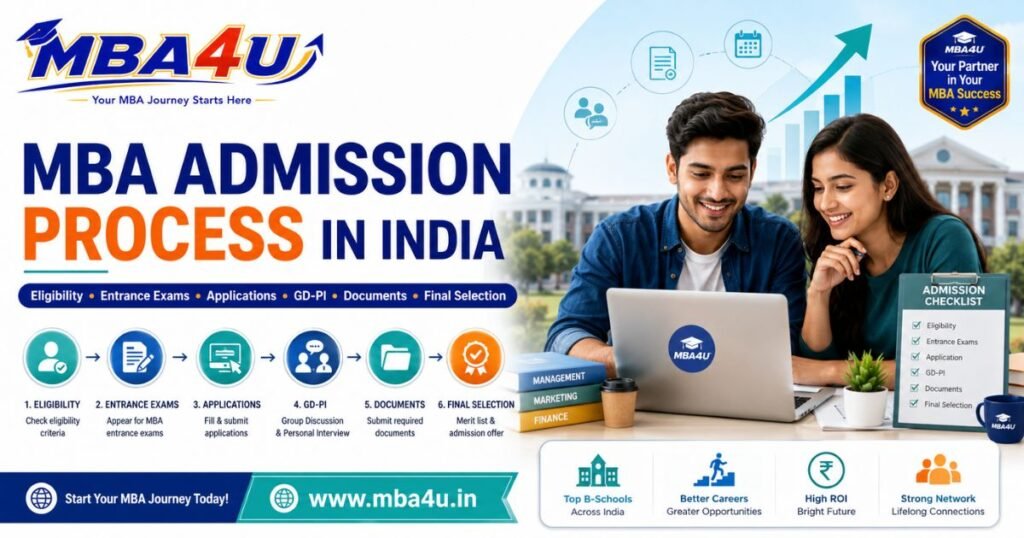
MBA Admission Process in India
MBA is one of the most popular postgraduate courses in India for students who want to build a career in business, management, leadership, consulting, finance, marketing, human resources, operations, analytics or entrepreneurship.
Every year, thousands of students apply for MBA and PGDM programs through national-level, state-level and university-level entrance exams. However, many students are confused about the actual MBA admission process in India. They often ask questions like: Which entrance exam should I take? How are colleges shortlisted? What happens after the exam? What documents are required? How do colleges select students?
This guide explains the complete MBA admission process in India in a simple and practical way.
What is MBA Admission Process?
The MBA admission process is the step-by-step method through which students apply to management colleges and get selected for MBA or PGDM programs.
In India, MBA admission usually includes:
Checking eligibility
Selecting entrance exams
Registering for MBA entrance tests
Appearing for exams
Applying to target colleges
Getting shortlisted
Attending GD, WAT, PI or other selection rounds
Document verification
Receiving final admission offer
Paying admission fee
Joining the MBA program
Different colleges may follow different admission processes. IIMs, private B-schools, university departments, deemed universities and state-level colleges may have separate selection rules.
MBA Admission Process in India: Quick Overview
| Step | Process |
|---|---|
| Step 1 | Check MBA eligibility |
| Step 2 | Choose MBA entrance exams |
| Step 3 | Register for entrance exams |
| Step 4 | Appear for exams |
| Step 5 | Check result and scorecard |
| Step 6 | Apply to B-schools |
| Step 7 | Get shortlisted |
| Step 8 | Attend GD, WAT, PI or counselling |
| Step 9 | Complete document verification |
| Step 10 | Pay admission fee and confirm seat |
MBA Eligibility Criteria in India
The basic eligibility for MBA admission in India is graduation from a recognized university. Students from Arts, Commerce, Science, Engineering, Medical, Law or any other stream can apply.
Common MBA Eligibility Requirements
Bachelor’s degree from a recognized university
Minimum 50% marks for General category candidates in many institutes
Minimum 45% marks for reserved category candidates in many institutes
Final-year graduation students can also apply in many colleges
Valid entrance exam score may be required
Some colleges may accept direct admission based on graduation marks
Work experience may be preferred for executive MBA or some premium programs
Important Note
Eligibility may vary from college to college. Students should always check the official admission brochure of the institute before applying.
Types of MBA Admission in India
MBA admission in India can happen through different routes.
1. Entrance Exam-Based Admission
This is the most common route for MBA admission. Students appear for entrance exams such as CAT, XAT, CMAT, MAT, NMAT, SNAP, ATMA, MAH MBA CET, TANCET MBA, OJEE MBA or other exams.
Colleges shortlist students based on entrance exam scores and further selection rounds.
2. Direct MBA Admission
Some private colleges offer direct admission based on graduation marks, academic profile and personal interview. Direct admission is more common in private universities and regional MBA colleges.
Students should carefully verify approval, fee, placement record and refund policy before taking direct admission.
3. State Counselling-Based Admission
Some states conduct MBA admission through a centralized counselling process. Students may need to appear for a state-level entrance exam or use accepted national-level exam scores.
Examples include:
MAH MBA CET for Maharashtra
TANCET MBA for Tamil Nadu
OJEE MBA for Odisha
KMAT Kerala
AP ICET
TS ICET
Karnataka PGCET
4. University-Level Admission
Some universities conduct their own entrance test, interview or merit-based admission process for MBA programs.
Examples include private universities, deemed universities and state universities.
5. Executive MBA Admission
Executive MBA is usually designed for working professionals. Admission may require work experience, interview, statement of purpose, recommendation letters or entrance scores.
Popular MBA Entrance Exams in India
MBA aspirants can choose entrance exams based on their target colleges, location preference and budget.
| Exam | Best For |
| CAT | IIMs and top MBA/PGDM colleges |
| XAT | XLRI, XIMB and many private B-schools |
| CMAT | AICTE-approved MBA/PGDM institutes |
| MAT | Private and regional B-schools |
| NMAT | NMIMS and participating colleges |
| SNAP | Symbiosis institutes |
| ATMA | Private MBA/PGDM colleges |
| MAH MBA CET | MBA colleges in Maharashtra |
| TANCET MBA | MBA colleges in Tamil Nadu |
| OJEE MBA | MBA colleges in Odisha |
| AP ICET | MBA colleges in Andhra Pradesh |
| TS ICET | MBA colleges in Telangana |
| Karnataka PGCET | MBA colleges in Karnataka |
Step-by-Step MBA Admission Process in India
Step 1: Decide Your MBA Goal
Before applying, students should clearly understand why they want to pursue an MBA.
Ask yourself:
Do I want a high-salary corporate career?
Do I want to switch career fields?
Do I want to enter finance, marketing, HR, operations or analytics?
Do I want to start my own business?
Do I want admission in top IIMs or a good regional college?
What is my budget for MBA fees?
Which city or state do I prefer?
A clear goal helps in choosing the right exam, college and specialization.
Step 2: Check MBA Eligibility
After deciding the goal, students should check whether they meet the eligibility criteria.
Most MBA colleges require a bachelor’s degree. Final-year students can also apply, but they must submit final mark sheets or degree proof within the required timeline.
Students should check:
Minimum graduation percentage
Accepted entrance exams
Reservation criteria
Final-year student rules
Work experience requirement
Age limit, if any
University recognition
Program-specific eligibility
Step 3: Choose the Right Entrance Exams
The next step is selecting entrance exams. Students should not randomly apply for every exam. They should choose exams based on target colleges.
For example:
For IIMs, CAT is required.
For XLRI, XAT is required.
For Symbiosis institutes, SNAP is required.
For NMIMS, NMAT is required.
For Maharashtra colleges, MAH MBA CET is useful.
For Odisha MBA colleges, OJEE MBA may be useful.
For many private colleges, CMAT, MAT and ATMA may help.
Students should make a list of target colleges first and then check which exam scores they accept.
Step 4: Register for MBA Entrance Exams
After choosing exams, students must register online through the official exam website.
During registration, students generally need:
Name and personal details
Email ID and mobile number
Academic details
Category details
Photograph
Signature
Exam city preference
Payment of application fee
Students should fill the form carefully because incorrect details may create problems during admit card, result or admission.
Step 5: Prepare for Entrance Exams
MBA entrance exam preparation depends on the exam pattern. Most exams test aptitude, reasoning, English and general awareness.
Common preparation areas include:
Quantitative Aptitude
Data Interpretation
Logical Reasoning
Verbal Ability
Reading Comprehension
General Awareness
Decision Making
Innovation and Entrepreneurship
Business Awareness
Students should prepare with a proper study plan, mock tests, previous-year questions and regular revision.
Step 6: Download Admit Card and Appear for Exam
Before the exam, candidates must download the admit card from the official website.
The admit card usually includes:
Candidate name
Roll number
Exam date
Exam time
Exam centre
Reporting time
Instructions
Photograph and signature
Students must carry the admit card along with valid photo ID proof to the exam centre.
Step 7: Check Result and Scorecard
After the entrance exam, results are declared online. Students can download their scorecard using login credentials.
The scorecard may include:
Overall score
Section-wise score
Percentile
Rank, if applicable
Candidate details
Validity details
Students should save the scorecard because it is required during college application and admission.
Step 8: Apply to MBA Colleges
This is one of the most important steps. Appearing for an entrance exam does not automatically mean admission to every college.
Students must separately apply to many B-schools by filling their application forms.
While applying, check:
Accepted entrance exam score
Application deadline
Program offered
MBA or PGDM approval
Course fee
Hostel fee
Placement report
Specializations
Location
Scholarships
Refund policy
Selection process
Step 9: Shortlisting by Colleges
After receiving applications, colleges shortlist candidates based on their admission criteria.
Shortlisting may depend on:
Entrance exam score
Percentile
Academic performance
Class 10 marks
Class 12 marks
Graduation marks
Work experience
Gender diversity
Academic diversity
Category
Statement of purpose
Profile strength
Top colleges usually follow a profile-based selection process, not only entrance marks.
Step 10: GD, WAT, PI or Counselling Round
Shortlisted students may be called for further selection rounds.
Common Selection Rounds
Group Discussion
A group discussion tests communication skills, awareness, confidence, leadership and logical thinking.
Written Ability Test
WAT checks writing ability, clarity of thought, grammar, structure and awareness of current topics.
Personal Interview
PI is one of the most important admission rounds. It tests personality, academic knowledge, career goals, confidence and MBA readiness.
Extempore
Some colleges ask students to speak on a topic for a short time.
Case Discussion
Some B-schools conduct case-based discussions to test analytical and decision-making ability.
Counselling
State-level MBA admissions often use counselling rounds where students choose colleges based on rank, score, category and seat availability.
Personal Interview Questions for MBA Admission
Students should prepare common MBA interview questions such as:
Tell me about yourself.
Why do you want to do MBA?
Why this college?
Why this specialization?
What are your strengths and weaknesses?
What are your short-term and long-term goals?
Explain your graduation project.
Why should we select you?
What are your hobbies?
What are your achievements?
Do you have work experience?
What is your career plan after MBA?
What is your understanding of business and management?
Students should answer honestly and confidently. The interview panel usually checks clarity, attitude, communication and seriousness.
Step 11: Final Merit List
After all selection rounds, colleges release a final merit list or admission offer.
The final selection may include weightage for:
Entrance exam score
GD score
WAT score
PI score
Academic record
Work experience
Diversity factors
Statement of purpose
Entrance rank
Seat availability
Every college has its own weightage system. Students should check the admission policy of each institute.
Step 12: Document Verification
Selected students must submit documents for verification.
Documents Required for MBA Admission
Class 10 marksheet and certificate
Class 12 marksheet and certificate
Graduation marksheets
Degree certificate or provisional certificate
Entrance exam scorecard
Entrance exam admit card
Photo identity proof
Passport-size photographs
Category certificate, if applicable
PwD certificate, if applicable
EWS certificate, if applicable
Migration certificate
Transfer certificate
Character certificate
Work experience certificate, if applicable
Gap certificate, if applicable
Domicile certificate, if applicable
Income certificate, if applicable
Fee payment receipt
Students should keep both original documents and scanned copies ready.
Step 13: Pay Admission Fee and Confirm Seat
After selection and document verification, students must pay the admission fee within the deadline.
Before paying, check:
Total course fee
Hostel fee
Security deposit
Refund policy
Scholarship rules
Loan support
Installment options
Placement claims
College approval
Program recognition
Location and campus facilities
Do not pay fees through unofficial agents or personal bank accounts. Always pay through official college payment channels.
Step 14: Attend Orientation and Start MBA
After confirming admission, students attend orientation and begin the MBA journey.
During orientation, colleges explain:
Academic calendar
Subjects
Specializations
Attendance rules
Placement process
Clubs and committees
Internship process
Examination system
Code of conduct
Students should use the first semester to build communication skills, Excel skills, presentation skills, reading habits and networking habits.
MBA Admission Timeline in India
| Month | Common MBA Admission Activity |
| July – September | CAT registration, XAT registration, NMAT registration, SNAP registration |
| October – December | Entrance exams, college applications, early admission forms |
| January – March | Results, shortlisting, GD-WAT-PI rounds, more applications |
| April – June | Final admission offers, counselling, seat booking |
| June – August | Session begins in many colleges |
This timeline may change depending on the exam and college. Students should follow official websites for exact dates.
MBA Admission Through CAT
CAT is the main exam for admission to IIMs and many top B-schools.
CAT Admission Process Usually Includes
CAT registration
CAT exam
CAT result
IIM shortlist
Personal Interview or other rounds
Final selection
Document verification
Admission offer
Top non-IIM B-schools may also accept CAT scores and conduct their own application and selection process.
MBA Admission Through CMAT
CMAT is accepted by many AICTE-approved institutions, university departments and affiliated colleges.
CMAT Admission Process Usually Includes
CMAT registration
CMAT exam
CMAT result
Apply to CMAT-accepting colleges
GD/PI or counselling, if applicable
Final selection
Fee payment and admission confirmation
CMAT can be useful for students targeting private, regional and AICTE-approved management institutes.
MBA Admission Through MAT
MAT is conducted multiple times a year and is accepted by many private B-schools.
MAT Admission Process Usually Includes
MAT registration
Choose test mode
Appear for MAT
Download scorecard
Apply to MAT-accepting colleges
Attend interview or admission process
Confirm admission
MAT is helpful for students who want more admission windows during the year.
MBA Admission Through State Entrance Exams
Many states conduct MBA admission through state-level exams or counselling.
Popular State-Level MBA Admission Routes
MAH MBA CET for Maharashtra
TANCET MBA for Tamil Nadu
OJEE MBA for Odisha
TS ICET for Telangana
AP ICET for Andhra Pradesh
Karnataka PGCET for Karnataka
KMAT Kerala for Kerala
State counselling is useful for students who want admission to universities and colleges within a particular state.
MBA Admission Without Entrance Exam
Some colleges offer MBA admission without national-level entrance exams. Admission may be based on graduation marks, interview or university-level process.
However, students should be careful while choosing such colleges.
Check Before Direct Admission
Is the college approved or recognized?
Is the MBA degree valid?
Is the PGDM AICTE-approved?
What is the total fee?
What is the placement record?
Are placement reports genuine?
What specializations are available?
Is there a refund policy?
Are there hidden charges?
What is the student feedback?
Direct admission can be useful for some students, but proper verification is necessary.
MBA vs PGDM Admission Process
MBA and PGDM admissions are similar in many ways, but there are some differences.
| Point | MBA | PGDM |
| Offered By | Universities and affiliated colleges | Autonomous institutes |
| Approval | University/UGC system, as applicable | AICTE approval required for PGDM |
| Admission Route | Entrance exam, merit, counselling, interview | Entrance exam, application, GD/PI |
| Curriculum | May follow university structure | Often industry-oriented and flexible |
| Degree/Diploma | Degree | Diploma |
| Selection Process | Varies by university | Varies by institute |
Students should check approval, recognition, curriculum, placements and industry acceptance before choosing MBA or PGDM.
How to Choose the Right MBA College
Choosing the right MBA college is very important because it affects learning, placements, networking and career growth.
Factors to Check Before Applying
Approval and recognition
Accepted entrance exams
Course fee
Hostel and other charges
Placement record
Average salary package
Highest salary package
Specializations offered
Faculty profile
Industry exposure
Internship support
Alumni network
Location
Corporate connections
Student reviews
Scholarship options
Loan support
Refund policy
Do not choose a college only because of advertisements, calls or discounts. Always compare facts.
MBA Course Fees in India
MBA fees in India vary widely depending on the college type, location, brand value and facilities.
| College Type | Approx. Fee Range |
| Government / State University Colleges | ₹50,000 – ₹3 lakh |
| Central University / Public Institutions | ₹1 lakh – ₹6 lakh |
| IIMs and Top Government Institutes | ₹10 lakh – ₹30 lakh |
| Private Universities | ₹5 lakh – ₹20 lakh |
| Top Private B-Schools | ₹12 lakh – ₹30 lakh |
| Regional Private MBA Colleges | ₹2 lakh – ₹8 lakh |
Students should compare total fee with placement outcomes before final admission.
MBA Selection Criteria in India
MBA selection is not always based only on entrance exam score. Many top colleges use multiple parameters.
Common Selection Criteria
Entrance exam score
Sectional cutoff
Overall percentile
Class 10 marks
Class 12 marks
Graduation marks
Work experience
Academic diversity
Gender diversity
GD performance
WAT performance
PI performance
Statement of purpose
Recommendation letters
Reservation category
Seat availability
A balanced profile can improve admission chances.
How to Improve MBA Admission Chances
Students can improve their admission chances by planning early.
Practical Tips
Apply to multiple colleges, not just one.
Choose colleges based on score range.
Prepare for GD, WAT and PI early.
Keep documents ready.
Track deadlines carefully.
Check official websites regularly.
Build a clear MBA career goal.
Improve communication skills.
Read business news daily.
Prepare a strong answer for “Why MBA?”
Compare fees and placements before paying.
Avoid fake admission promises.
Common Mistakes During MBA Admission
Missing application deadlines
Applying only to dream colleges
Ignoring backup colleges
Not checking approval and recognition
Believing fake placement claims
Not preparing for interviews
Submitting wrong documents
Waiting until the last date to apply
Not checking refund rules
Choosing college only by low fee
Ignoring specialization fit
Not comparing ROI
Paying through unofficial agents
Avoiding these mistakes can protect students from poor admission decisions.
MBA Admission for Final-Year Students
Final-year graduation students can apply to many MBA colleges. However, they must submit final marksheets or degree proof within the timeline given by the college.
Final-Year Students Should Keep Ready
Previous semester marksheets
College ID
Provisional certificate, if available
Expected graduation completion proof
Entrance exam scorecard
Category certificate, if applicable
Identity proof
Updated resume
If final result is delayed, students should inform the college and follow official instructions.
MBA Admission for Working Professionals
Working professionals can apply for full-time MBA, executive MBA, online MBA or part-time MBA depending on their career goal.
Useful Options
Full-time MBA for career switch
Executive MBA for experienced professionals
Online MBA for flexibility
Part-time MBA for working students
PGDM for industry-oriented learning
Working professionals should highlight work experience, achievements, leadership roles, projects and career goals during interviews.
MBA Admission in Odisha
Odisha students can apply through national-level exams as well as state-level options.
Common Admission Routes for Odisha Students
CAT
XAT
CMAT
MAT
ATMA
OJEE MBA
College-level admission process
University-level admission process
Popular MBA/PGDM Colleges in Odisha to Check
XIM University / XIMB
KIIT School of Management
SOA University
Birla Global University
Regional College of Management Bhubaneswar
IMIS Bhubaneswar
Sri Sri University
RIMS Rourkela
GIET University
Centurion University
Utkal University
Ravenshaw University
Students should verify accepted exams, deadlines, fees and admission criteria from each official college website.
MBA Admission Checklist
Before applying to any MBA college, check this list:
Eligibility criteria
Accepted entrance exams
Application deadline
Application fee
Total course fee
Hostel fee
Approval and recognition
Specializations offered
Placement report
Average package
Internship support
Location
Scholarship options
Education loan support
GD/PI process
Required documents
Refund policy
Official website link
Final Thoughts
The MBA admission process in India can look confusing at first because every exam and college has its own rules. However, the process becomes simple when students follow a step-by-step approach.
Start by understanding your career goal. Then choose the right entrance exams, apply to suitable colleges, prepare for GD-WAT-PI, keep documents ready and verify all details before paying the admission fee.
A good MBA admission decision should not be based only on college name or advertisement. Students should compare entrance route, fee, placement, specialization, approval, location and return on investment.
With proper planning, MBA aspirants can choose the right college and begin a successful management career.
Want to know more about CMAT Exam & CAT Exam?
Use MBA4U to explore MBA entrance exams, compare colleges, check admission notifications and find the best MBA/PGDM program based on exam score, fee, location and specialization.
FAQs on MBA Admission Process in India
What is the MBA admission process in India?
The MBA admission process usually includes eligibility checking, entrance exam registration, exam appearance, college application, shortlisting, GD/WAT/PI or counselling, document verification and fee payment.
Which entrance exam is best for MBA admission?
CAT is best for IIMs and many top B-schools. XAT, CMAT, MAT, NMAT, SNAP, ATMA and state-level exams are also useful depending on the target college.
Can I get MBA admission without CAT?
Yes. Many colleges accept XAT, CMAT, MAT, NMAT, SNAP, ATMA, state-level exams or direct admission based on graduation marks and interview.
Can I get MBA admission without entrance exam?
Some private colleges offer direct MBA admission without national-level entrance exams. However, students should verify approval, fees, placements and recognition before applying.
What is the minimum percentage required for MBA?
Many colleges require at least 50% marks in graduation for General category candidates and 45% for reserved category candidates. However, eligibility may vary by institute.
Is work experience required for MBA admission?
Work experience is not compulsory for most full-time MBA programs. However, it may improve profile strength in some top B-schools and is usually important for executive MBA programs.
What documents are required for MBA admission?
Common documents include Class 10 and 12 marksheets, graduation marksheets, degree certificate, entrance scorecard, admit card, ID proof, photographs, category certificate, migration certificate and other college-specific documents.
What is GD, WAT and PI in MBA admission?
GD means Group Discussion, WAT means Written Ability Test and PI means Personal Interview. These rounds test communication, writing ability, awareness, personality and MBA readiness.
How should I choose an MBA college?
Choose an MBA college by checking approval, accepted exams, fee, placements, specialization, location, faculty, industry exposure, alumni network and return on investment.
When does MBA admission start in India?
MBA admission activity usually begins from July to September with entrance exam registrations and continues until June or August of the next year, depending on the college and admission cycle.
Website Disclaimer
MBA admission rules, entrance exam dates, eligibility, fees, cutoffs, selection criteria and accepted exams may change every year. Students should verify the latest details from official exam websites and official college admission pages before applying.