
Looking for MBA scholarships in India? Check PM Vidyalaxmi Scheme, education loan support, government scholarships, private scholarships, eligibility, documents and application process.
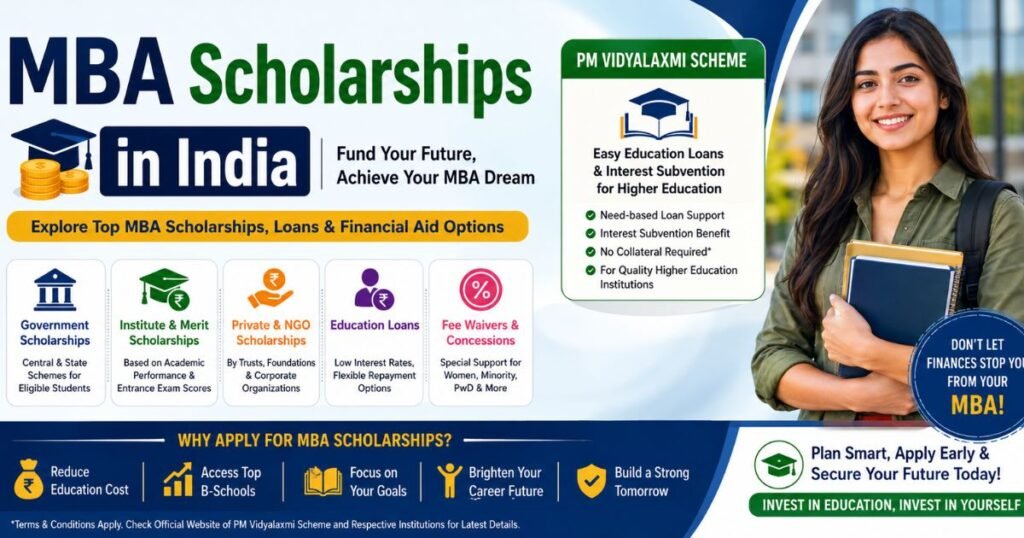
MBA Scholarships in India
MBA is one of the most popular postgraduate courses in India, but the cost of management education can be a major concern for students and parents. Fees for MBA and PGDM programmes can range from a few thousand rupees in government universities to several lakhs in private B-schools and premium institutes.
Because of this, many students search for MBA scholarships in India before taking admission.
The good news is that MBA students may get financial support through different routes such as government scholarships, state scholarships, private scholarships, institute-level scholarships, merit-based fee waivers, need-based assistance, education loans and interest subsidy schemes.
One important scheme that MBA aspirants should understand is the PM Vidyalaxmi Scheme. It is not a traditional scholarship where the full fee is directly waived. It is mainly a financial support and education loan-based scheme designed to help students access quality higher education. Under PM Vidyalaxmi, students admitted to identified Quality Higher Education Institutions can get need-based education loan support, and eligible students may also get interest subvention benefits. The scheme is available for students admitted to 860 identified Quality Higher Education Institutions, as reported in the Economic Times based on PNB’s PM Vidyalaxmi education loan update.
This complete guide explains MBA scholarships in India, PM Vidyalaxmi Scheme, eligibility, benefits, documents, application process, types of MBA financial aid and tips to reduce MBA education cost.
What Are MBA Scholarships?
MBA scholarships are financial support options that help students reduce the cost of MBA education. These may be offered by the government, state departments, universities, private organizations, banks, corporate foundations or B-schools.
MBA scholarships may be based on:
Merit
Family income
Social category
Gender
Academic performance
Entrance exam score
Minority status
Disability
State domicile
College policy
Professional background
Need-based financial condition
Some scholarships directly reduce tuition fees. Some provide cash assistance. Some reimburse fees after admission. Some provide interest subsidy on education loans.
So, students should understand one thing clearly:
MBA scholarship does not always mean free MBA. It can mean fee waiver, reimbursement, stipend, education loan support or interest subsidy.
MBA Scholarships in India: Quick Overview
| Particular | Details |
|---|---|
| Topic | MBA Scholarships in India |
| Best For | MBA, PGDM, online MBA, distance MBA and management aspirants |
| Support Type | Scholarship, fee waiver, reimbursement, loan, interest subsidy |
| Main Sources | Government, state schemes, colleges, private trusts, banks |
| Key Scheme Focus | PM Vidyalaxmi Scheme |
| Eligibility | Depends on scheme |
| Common Criteria | Income, merit, category, institute, course, documents |
| Application Mode | Mostly online |
| Important Portals | Official scholarship portals, college websites, bank portals |
| Main Caution | Verify official source before applying |
Why MBA Scholarships Are Important
MBA education can be expensive. Many students have the ability and ambition to pursue management education, but financial pressure stops them from choosing good colleges.
MBA scholarships can help students by:
Reducing tuition fee burden
Supporting students from low-income families
Helping meritorious students access better institutions
Reducing dependence on high-interest loans
Supporting women and reserved category students
Helping students continue higher education
Making professional education more inclusive
Improving access to quality management education
For MBA aspirants, financial planning is as important as entrance exam preparation.
PM Vidyalaxmi Scheme for MBA Students
The PM Vidyalaxmi Scheme is an important education finance initiative for students pursuing higher education. For MBA aspirants, it can be especially useful if they get admission into an eligible Quality Higher Education Institution.
The scheme is designed to provide financial support through education loans. According to the Economic Times report, PM Vidyalaxmi supports students admitted on merit to identified Quality Higher Education Institutions across India, and financing is need-based depending on the student’s requirement.
For MBA students, this matters because many good B-schools have high fees. Even if a student does not get a direct scholarship, education loan support with interest subvention can reduce the financial pressure.
Is PM Vidyalaxmi a Scholarship?
PM Vidyalaxmi is better understood as an education loan and interest support scheme, not a direct MBA scholarship in the traditional sense.
A scholarship usually means money given to students without repayment. An education loan must be repaid after the moratorium or repayment period. PM Vidyalaxmi helps students access education loans more easily, and eligible students may get interest subvention benefits.
So, for MBA aspirants:
Scholarship = may not require repayment
Education loan = requires repayment
Interest subvention = government support on interest, subject to eligibility
PM Vidyalaxmi = education loan support with possible interest benefit
This distinction is important before applying.
PM Vidyalaxmi Scheme: Key Highlights
| Particular | Details |
|---|---|
| Scheme Name | PM Vidyalaxmi Scheme |
| Main Purpose | Financial support for higher education |
| Useful For | Students admitted to eligible higher education institutions |
| Course Type | Undergraduate, postgraduate degree/diploma courses |
| MBA Applicability | May apply if the MBA/PGDM institute is eligible under the scheme |
| Support Type | Education loan and interest subvention |
| Eligible Institutes | Identified Quality Higher Education Institutions |
| Collateral | Reported as not required under the scheme |
| Joint Borrower | Parent/guardian may be required as joint borrower |
| Application Route | Through official/bank education loan process |
| Important Check | Confirm institute eligibility and bank rules before applying |
The Economic Times report states that collateral is not required under the PM Vidyalaxmi scheme, but parents or guardians must be joint borrowers on the loan.
PM Vidyalaxmi Eligibility for MBA Students
MBA students should check the latest official scheme rules and bank-specific guidelines before applying. Based on the reported scheme structure, students should focus on the following eligibility points.
Common Eligibility Points
Student should be an Indian national, and some bank interpretations may also include NRI/OCI categories depending on scheme and lender rules.
Student should have secured admission on merit to an eligible Quality Higher Education Institution.
The MBA, PGDM or management programme should be part of the eligible course/institution framework.
The loan should be used for higher education expenses.
Family income may decide interest subvention eligibility.
Bank may require KYC, academic documents, admission letter and fee structure.
Parent or guardian may be required as a joint borrower.
The Economic Times report mentions that the scheme is open to students pursuing graduation or postgraduation degree/diploma courses in Qualified Higher Education Institutions.
PM Vidyalaxmi Interest Subvention
Interest subvention means the government supports part of the interest burden for eligible students. This does not always mean the full loan is free.
According to the Economic Times report, students from families with annual income up to ₹4.5 lakh may get 100% interest subvention under PM-USP CSIS for technical/professional courses, while students with family income between ₹4.5 lakh and ₹8 lakh may get 3% interest subvention under PM Vidyalaxmi. The report also states that for other courses, a 3% interest subvention is available under PM Vidyalaxmi depending on the scheme structure mentioned.
MBA aspirants should verify the final benefit from the official portal, bank branch or bank website because interest rates, subvention rules and eligible course classifications may change.
PM Vidyalaxmi Loan Margin and Interest Rate
The exact loan margin and interest rate may vary depending on bank rules, institute category and student profile.
According to the Economic Times report, PNB categorized eligible institutions into AAA, AA and A groups, and stated that no margin is required for students enrolled in AAA and AA-rated institutes. For other institutes, the report mentions no margin for loans up to ₹4 lakh and 5% margin above ₹4 lakh. The same report says interest rates are institute-specific and start at 7.50% per annum in the context of PNB’s update.
Students should treat this as bank-specific information and verify the latest rates directly with the bank before applying.
Documents Required for PM Vidyalaxmi Scheme
Documents may vary by bank and student profile. However, MBA aspirants should generally keep these documents ready.
| Document | Why It Is Needed |
|---|---|
| Aadhaar card | Identity verification |
| PAN card | KYC and financial record |
| Address proof | Residence verification |
| Class 10 and 12 marksheets | Academic record |
| Graduation marksheets | MBA eligibility proof |
| Entrance exam scorecard | Admission and merit proof |
| Admission offer letter | Proof of admission |
| Fee structure | Loan amount calculation |
| Passport-size photographs | Application requirement |
| Family income proof | Interest subvention eligibility |
| Existing loan details | Bank credit assessment |
| Bank account details | Loan processing |
| Co-borrower documents | Parent/guardian verification |
The Economic Times report lists KYC details, previous qualifying marksheets, entrance exam result, institution offer letter with fee structure, photographs, existing loan details and family income proof among documents required as per PNB’s website.
How to Apply for PM Vidyalaxmi Scheme
MBA students should apply carefully through the official route. Do not depend only on third-party agents or unofficial counsellors.
Step-by-Step Process
- Check whether your MBA college is eligible under the scheme.
- Visit the official PM Vidyalaxmi or education loan portal.
- Register with your basic details.
- Fill personal, academic and admission details.
- Upload required documents.
- Select the bank or loan scheme, if applicable.
- Submit the application.
- Track application status.
- Respond to bank queries.
- Complete KYC and co-borrower formalities.
- Verify loan sanction details.
- Confirm interest rate, repayment terms and subvention benefits.
- Accept loan only after understanding all terms.
Students should always read the sanction letter carefully before accepting the loan.
PM Vidyalaxmi Scheme: Benefits for MBA Students
PM Vidyalaxmi can help MBA aspirants in several ways.
1. Access to Higher Education Finance
Students who cannot pay MBA fees upfront may use education loan support.
2. Useful for Costly MBA Programmes
MBA fees at reputed institutions can be high. A structured education loan can make admission possible.
3. Interest Subvention Benefit
Eligible students may get interest support, reducing the loan burden.
4. No Collateral Benefit
The Economic Times report states that collateral is not required under the PM Vidyalaxmi scheme, though parent/guardian joint borrowing may apply.
5. Supports Quality Institutions
The scheme focuses on identified Quality Higher Education Institutions, which may help students prioritize recognized and better-quality institutions.
6. Helpful for Middle-Income Families
Students from families that are not poor enough for some scholarships but still cannot afford high MBA fees may benefit from loan and interest support.
PM Vidyalaxmi Scheme: Limitations Students Should Understand
PM Vidyalaxmi is useful, but students should understand its limitations.
It is not free money.
Education loan must be repaid.
Interest subvention depends on eligibility.
Institute must be eligible.
Bank approval is still required.
Family income proof may be needed.
Repayment responsibility remains with student and co-borrower.
Interest rate may vary by bank and institute category.
Students must verify current scheme rules before applying.
MBA aspirants should calculate EMI, expected salary, repayment period and total interest before taking a loan.
Types of MBA Scholarships in India
MBA students can explore different types of scholarships and financial aid.
1. Government Scholarships
These are offered by central or state governments for eligible students. They may be based on category, income, merit or domicile.
Common categories include:
SC scholarships
ST scholarships
OBC scholarships
EBC scholarships
Minority scholarships
PwD scholarships
State domicile scholarships
Merit-cum-means scholarships
2. State Government Scholarships
Many states offer scholarships for postgraduate students, including MBA students, depending on category and income.
Students should check their state scholarship portal.
Examples of state-level scholarship types:
Post-matric scholarship
Higher education scholarship
Merit scholarship
Fee reimbursement scheme
Minority scholarship
Women’s education support
Backward class welfare scholarship
3. Institute-Level MBA Scholarships
Many MBA colleges offer scholarships based on:
Entrance exam score
Graduation marks
Academic performance
Need-based profile
Women candidates
Defence background
Sports achievement
Diversity profile
Sibling benefit
Early admission policy
Students should check the official scholarship page of each B-school.
4. Merit-Based MBA Scholarships
These are awarded to students with strong academic or entrance exam performance.
Common criteria may include:
High CAT/XAT/CMAT/MAT/NMAT score
High graduation marks
Strong Class 10 and 12 marks
Top rank in admission process
Semester performance after admission
5. Need-Based MBA Scholarships
These are given to students from financially weaker backgrounds.
Common requirements include:
Family income certificate
Bank statement
ITR or non-ITR declaration
Fee structure
Admission proof
Academic record
Recommendation letter, if required
6. Private Scholarships
Private foundations, NGOs, corporate groups and charitable trusts may support MBA or postgraduate education.
Students should check:
Corporate CSR scholarships
Community scholarships
Foundation grants
Education trusts
Alumni-funded scholarships
Women leadership scholarships
7. Education Loans with Subsidy
Education loans are not scholarships, but interest subsidy can reduce the cost of borrowing.
PM Vidyalaxmi is important in this category.
Popular MBA Scholarship Sources in India
| Scholarship Source | Who Should Check |
|---|---|
| Central government scholarship portals | Category/income-based students |
| State scholarship portals | Students with state domicile |
| B-school scholarship pages | All MBA applicants |
| PM Vidyalaxmi Scheme | Students needing education loan support |
| Bank education loans | Students needing fee financing |
| Private foundations | Meritorious and needy students |
| Corporate CSR scholarships | Students from specific backgrounds |
| Minority scholarship portals | Eligible minority students |
| AICTE-related schemes | Students in approved technical/management institutions |
| Alumni scholarships | Students admitted to reputed institutes |
MBA Scholarships for Different Students
MBA Scholarships for SC/ST Students
SC/ST students may get support through central or state post-matric scholarship schemes, fee reimbursement schemes or institutional financial aid. Eligibility usually depends on category certificate, income certificate, admission proof and institute recognition.
MBA Scholarships for OBC Students
OBC students may apply for state or central schemes depending on family income and domicile. Requirements usually include OBC certificate, income certificate and academic documents.
MBA Scholarships for Minority Students
Students from minority communities may check minority scholarship schemes offered by central or state authorities, depending on current availability and eligibility.
MBA Scholarships for Women
Some B-schools and private foundations offer scholarships or fee waivers for women candidates to improve gender diversity in management education.
MBA Scholarships for PwD Students
Students with disabilities can check PwD scholarships, state support schemes and institutional concessions.
MBA Scholarships for Meritorious Students
Students with high entrance exam scores or strong academic profiles should check institute-level merit scholarships.
MBA Scholarships Based on Entrance Exam Score
Many private B-schools offer scholarships based on entrance exam scores.
Common exams used for scholarship decisions include:
CAT
XAT
CMAT
MAT
NMAT
SNAP
ATMA
GMAT
State MBA entrance exams
For example, a college may offer fee waiver to students with high CAT percentile, strong XAT score or excellent CMAT rank. Rules vary from college to college.
Students should check:
Scholarship percentage
Minimum score required
Renewal criteria
Whether scholarship is for first year or full course
Whether scholarship applies to tuition fee only
Whether hostel and other charges are excluded
MBA Scholarships Based on Academic Performance
Some institutes provide scholarships based on academic performance in Class 10, Class 12, graduation or semester results.
Students with consistent academic record should ask the admission office about merit-based scholarship.
Common criteria may include:
80% or above in graduation
High score in Class 10 and 12
University rank
Semester topper status
High CGPA after first semester
Strong admission interview performance
MBA Scholarships Based on Family Income
Need-based scholarships help students from low-income or middle-income families.
Common documents required:
Income certificate
Salary certificate
ITR documents
Bank statement
BPL/EWS certificate, if applicable
Affidavit, if required
Fee structure
Admission letter
Students should apply early because need-based scholarships may have limited seats and strict deadlines.
How to Find MBA Scholarships in India
MBA aspirants should not wait until admission is over. Scholarship research should start before applying to colleges.
Step-by-Step Scholarship Search Plan
- Make a list of target MBA colleges.
- Visit each college’s official scholarship page.
- Check government scholarship portals.
- Check your state scholarship portal.
- Check PM Vidyalaxmi eligibility.
- Check education loan interest subsidy options.
- Ask college admission office about fee waivers.
- Search for private foundation scholarships.
- Prepare income and category documents early.
- Track deadlines carefully.
Scholarship opportunities are often missed because students apply late or do not keep documents ready.
How to Apply for MBA Scholarships
Step 1: Check Eligibility
Read the scholarship rules carefully. Do not apply without checking income, category, course, institute and academic conditions.
Step 2: Collect Documents
Keep academic, identity, income and admission documents ready.
Step 3: Fill Application Form
Apply through the official portal or college website.
Step 4: Upload Documents
Upload clear scanned copies. Avoid blurred or incorrect documents.
Step 5: Submit Before Deadline
Late applications are usually rejected.
Step 6: Track Application
Check status regularly and respond to queries.
Step 7: Save Receipts
Keep acknowledgement, application number and email confirmations safely.
Documents Required for MBA Scholarships in India
| Document | Required For |
|---|---|
| Aadhaar card | Identity verification |
| PAN card | Financial/KYC verification |
| Class 10 marksheet | Academic proof |
| Class 12 marksheet | Academic proof |
| Graduation marksheets | MBA eligibility |
| Entrance exam scorecard | Merit scholarship |
| Admission letter | Proof of admission |
| Fee structure | Scholarship/loan calculation |
| Income certificate | Need-based scholarship |
| Caste/category certificate | Category scholarship |
| Domicile certificate | State scholarship |
| Bank passbook | Scholarship transfer |
| Passport-size photo | Application form |
| Disability certificate | PwD scholarship |
| Minority certificate, if needed | Minority scholarship |
| Bonafide certificate | Institute verification |
MBA Scholarship Application Mistakes to Avoid
Avoid these common mistakes:
Applying after deadline
Using unofficial links
Uploading unclear documents
Entering wrong bank details
Not checking eligibility
Not matching name across documents
Ignoring renewal rules
Not saving application receipt
Not checking college-level scholarships
Confusing education loan with scholarship
Not verifying PM Vidyalaxmi eligibility
Depending only on counsellor promises
A small mistake can delay or reject your scholarship application.
PM Vidyalaxmi vs MBA Scholarship
| Point | PM Vidyalaxmi Scheme | MBA Scholarship |
|---|---|---|
| Type | Education loan and interest support | Financial aid or fee waiver |
| Repayment | Loan must be repaid | Usually no repayment |
| Eligibility | Institute, admission, income, bank rules | Merit, income, category, college rules |
| Best For | Students needing loan support | Students eligible for fee assistance |
| Benefit | Loan access and possible interest subvention | Direct fee reduction or cash support |
| Application Route | Official portal/bank | Scholarship portal/college |
| MBA Use | Useful for high-fee programmes | Useful for reducing fee burden |
Students should explore both. A scholarship can reduce fee, while PM Vidyalaxmi can help finance the remaining cost.
How MBA Students Can Reduce Education Cost
MBA aspirants can reduce financial pressure through smart planning.
1. Apply to Government Colleges
Government MBA colleges usually have lower fees.
2. Compare ROI
Do not choose a college only by brand. Compare total fee with average and median placement.
3. Apply for Scholarships Early
Many scholarship deadlines close before or soon after admission.
4. Use PM Vidyalaxmi if Eligible
Students admitted to eligible institutions can check education loan support and interest subvention.
5. Choose Hostel Carefully
Living cost can increase MBA expenses significantly.
6. Look for Assistantships
Some institutes offer teaching assistantship, research assistantship or campus work support.
7. Avoid Unnecessary Add-On Costs
Check whether laptop, foreign trip, certification or immersion charges are compulsory.
8. Negotiate Loan Terms
Compare banks for interest rate, processing fee, moratorium and repayment flexibility.
MBA Education Loan Checklist
Before taking an MBA education loan, check:
Total loan amount
Interest rate
Fixed or floating rate
Moratorium period
Repayment period
EMI after course completion
Processing fee
Prepayment charges
Collateral requirement
Co-borrower requirement
Insurance charges
Subvention eligibility
Tax benefit under Section 80E
Late payment penalty
Loan disbursement schedule
Do not sign loan documents without understanding repayment responsibility.
Is PM Vidyalaxmi Useful for MBA Students?
Yes, PM Vidyalaxmi can be useful for MBA students if:
The student gets admission to an eligible institution
The MBA or PGDM programme qualifies under the scheme/bank rules
The student needs education loan support
Family income meets interest subvention rules
The bank approves the loan
The student understands repayment responsibility
It may not help if:
The institute is not eligible
The student does not need a loan
Income criteria are not met for subvention
The bank does not approve the loan
The student expects a full fee waiver like a scholarship
The scheme is especially useful for students who get admission into a good B-school but cannot manage the full fee immediately.
MBA Scholarships in India: Best Strategy for Students
Here is a practical strategy for MBA aspirants:
First, shortlist colleges based on admission chances and ROI.
Second, check each college’s scholarship policy.
Third, check government and state scholarship portals.
Fourth, check PM Vidyalaxmi and education loan options.
Fifth, keep income, category and academic documents ready.
Sixth, apply early and track every application.
The right combination of scholarship, fee waiver and education loan can make MBA more affordable.
Final Thoughts
MBA scholarships in India can help students reduce the cost of management education, but students must search carefully and apply on time. Scholarships may come from the government, state departments, private foundations, B-schools, corporate groups or alumni funds.
PM Vidyalaxmi Scheme is an important financial support option for higher education aspirants. For MBA students, it can help through education loan access and possible interest subvention if the student, institute and family income meet the required conditions. However, students should remember that PM Vidyalaxmi is mainly loan-based support, not a full scholarship.
Before taking admission or applying for financial aid, always verify the latest rules from official portals, college websites and bank sources. Do not depend only on advertisements or admission agents.
A well-planned scholarship and education loan strategy can help students pursue MBA without unnecessary financial stress.
FAQs on MBA Scholarships in India
What are the best MBA scholarships in India?
The best MBA scholarships depend on your category, income, academic record, entrance exam score, state domicile and college. Students should check government scholarships, state scholarships, institute scholarships, private scholarships and PM Vidyalaxmi loan support.
Is PM Vidyalaxmi a scholarship?
PM Vidyalaxmi is mainly an education loan and interest support scheme. It is not a traditional scholarship where the full fee is waived.
Can MBA students apply for PM Vidyalaxmi Scheme?
MBA students may apply if they are admitted to an eligible Quality Higher Education Institution and meet the scheme and bank requirements.
Does PM Vidyalaxmi require collateral?
The Economic Times report on PNB’s PM Vidyalaxmi update states that collateral is not required under the scheme, but parents or guardians must be joint borrowers.
What is the interest subvention under PM Vidyalaxmi?
Interest subvention depends on family income, course type and scheme rules. The Economic Times report mentions 3% interest subvention under PM Vidyalaxmi for eligible students in relevant income categories.
Can I get a full MBA scholarship in India?
Yes, some institutes and organizations may offer large fee waivers or full scholarships, but they are usually limited and competitive.
Are MBA scholarships based on CAT score?
Many B-schools offer merit scholarships based on CAT, XAT, CMAT, MAT, NMAT or other entrance exam scores. Rules vary by college.
Can OBC students get MBA scholarships?
OBC students may be eligible for state or central scholarship schemes depending on income, domicile and course/institute recognition.
Can SC/ST students get MBA scholarships?
Yes, SC/ST students may be eligible for post-matric scholarships, fee reimbursement schemes and institute-level support, subject to official rules.
Can women get MBA scholarships?
Yes, some institutes and private foundations offer scholarships or fee waivers for women candidates to encourage diversity in management education.
What documents are required for MBA scholarship?
Common documents include Aadhaar, PAN, marksheets, admission letter, fee structure, income certificate, category certificate, bank details and entrance exam scorecard.
Where should I apply for MBA scholarships?
Apply through official government scholarship portals, state scholarship portals, college websites, private foundation portals or official education loan portals.