
Read this complete GMAT Exam Guide for MBA aspirants. Check GMAT eligibility, exam pattern, syllabus, registration process, score validity, preparation tips and top colleges accepting GMAT scores in India.
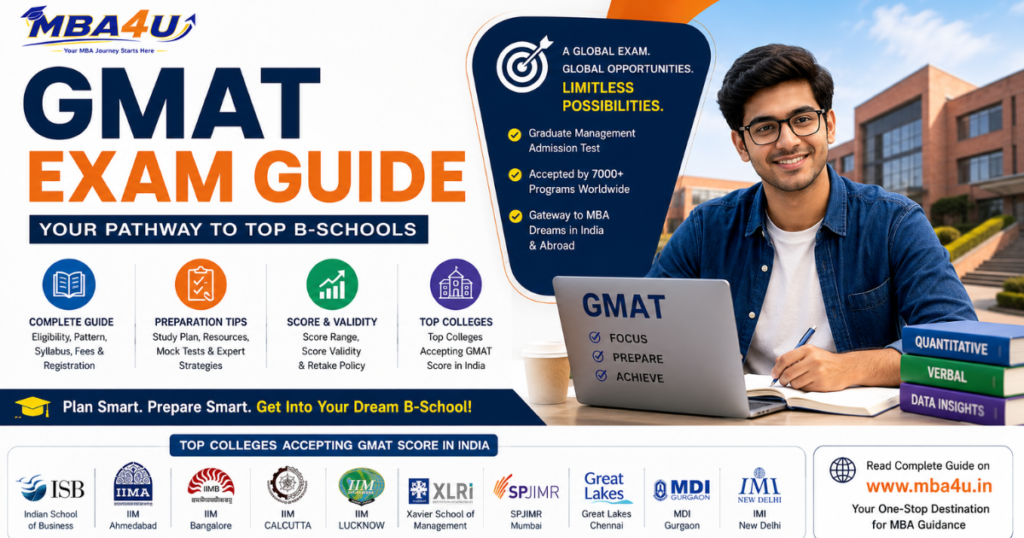
GMAT Exam Guide: Complete Guide for MBA Aspirants in India
The GMAT Exam Guide is useful for students and working professionals who want to apply for MBA, Executive MBA, one-year MBA, global MBA, management programmes and selected business schools in India and abroad.
GMAT stands for Graduate Management Admission Test. It is a globally accepted management entrance exam used by business schools to assess skills required for graduate management education. According to GMAC, GMAT scores are used by thousands of business and management programmes across the world.
In India, GMAT is especially important for candidates targeting ISB, one-year MBA programmes at IIMs, Executive MBA programmes, global MBA options, and selected PGDM programmes. It is also preferred by professionals who have work experience and want to move into leadership, consulting, product management, finance, strategy, analytics or international business roles.
What is the GMAT Exam?
The GMAT is a computer-based management entrance exam designed to test business-relevant skills. It evaluates how well a candidate can analyse data, understand written information, solve quantitative problems and make logical decisions.
The GMAT is different from exams like CAT, XAT or CMAT because it is accepted globally and appointments are available throughout the year. MBA.com states that GMAT can be taken at test centres across the world or online, depending on availability and applicable exam rules.
For Indian MBA aspirants, GMAT is mainly useful for:
Management programmes abroad
One-year MBA programmes in India
Executive MBA programmes
ISB PGP and related programmes
Selected PGDM and global management programmes
Admissions where international applicants or experienced professionals are considered
GMAT Exam Highlights
| Particular | Details |
|---|---|
| Exam Name | GMAT |
| Full Form | Graduate Management Admission Test |
| Conducting Body | GMAC |
| Official Website | mba.com |
| Exam Mode | Test centre or online, depending on availability |
| Exam Duration | 2 hours 15 minutes |
| Total Questions | 64 |
| Main Sections | Quantitative Reasoning, Verbal Reasoning, Data Insights |
| Best For | MBA, Executive MBA, One-Year MBA, Global MBA |
| Score Validity | Generally 5 years |
| Accepted By | Business schools in India and abroad |
MBA.com confirms that the current GMAT exam has three sections, 64 questions and a total testing time of 2 hours 15 minutes, with an optional 10-minute break.
GMAT Exam Pattern
The GMAT exam has three major sections:
| Section | Questions | Time |
|---|---|---|
| Quantitative Reasoning | 21 Questions | 45 Minutes |
| Verbal Reasoning | 23 Questions | 45 Minutes |
| Data Insights | 20 Questions | 45 Minutes |
| Total | 64 Questions | 2 Hours 15 Minutes |
The three sections are designed to test skills that are important for management education, such as numerical reasoning, reading ability, business communication, interpretation of data and problem-solving.
GMAT Syllabus
The GMAT syllabus is not based on a fixed school or university textbook. It tests aptitude, reasoning and business-readiness.
1. Quantitative Reasoning
This section checks numerical and problem-solving ability.
Important areas include:
Arithmetic
Algebra
Number properties
Ratios and percentages
Word problems
Rates and work
Basic statistics
Problem solving
This section does not test advanced engineering mathematics. A strong understanding of basic mathematics, speed and accuracy can help candidates perform better.
2. Verbal Reasoning
This section checks reading, grammar, logic and written communication skills.
Important areas include:
Reading comprehension
Critical reasoning
Logical interpretation
Argument analysis
Inference-based questions
Business communication understanding
Students who read regularly and practise reasoning-based questions can improve their verbal performance.
3. Data Insights
This is one of the most important sections of the current GMAT exam. It checks whether a candidate can interpret, analyse and use data for decision-making.
Important areas include:
Data interpretation
Table analysis
Graphs and charts
Multi-source reasoning
Two-part analysis
Numerical and verbal data-based reasoning
This section is highly relevant for modern MBA careers because managers are expected to work with data, reports and business insights.
GMAT Eligibility Criteria
GMAC does not prescribe a strict academic eligibility rule like many Indian entrance exams. However, business schools have their own admission criteria.
In general, candidates should have:
A bachelor’s degree or equivalent qualification
Valid GMAT score
Academic records
Work experience, especially for one-year MBA or Executive MBA programmes
Statement of purpose, essays or application form
Letters of recommendation, where required
Interview performance
For Indian B-schools, candidates must check each college’s official admission page because eligibility can differ by programme.
For example, ISB PGP requires a valid GMAT or GRE score along with work experience requirements for its Post Graduate Programme in Management.
GMAT Registration Process
GMAT registration is done through the official MBA.com portal.
The basic steps are:
Create an account on MBA.com
Click the register option
Complete the candidate profile
Choose exam mode, centre, date and time
Pay the exam fee
Download confirmation details
Appear for the exam as per the scheduled appointment
MBA.com officially explains that candidates need to create an MBA.com account, complete their profile, choose the test centre or online appointment and submit payment to schedule the exam.
GMAT Score Validity
GMAT scores are generally valid for five years. GMAC states that students may send their GMAT scores to programmes up to five years after taking the exam.
This is useful for candidates who want to prepare early and apply later. However, colleges may set their own score validity rules for specific admission cycles, so always check the official programme page before applying.
Who Should Take the GMAT?
The GMAT can be a good option for:
Working professionals planning a one-year MBA
Students targeting international MBA programmes
Candidates applying to ISB
Candidates applying to Executive MBA programmes
Professionals aiming for global management careers
Candidates who want flexibility in exam scheduling
Applicants who want to apply to selected Indian B-schools using GMAT score
GMAT may not be necessary for every MBA aspirant in India. For regular two-year MBA admission in many Indian colleges, CAT, XAT, CMAT, MAT, NMAT or SNAP may be more relevant. GMAT is most useful when your target college specifically accepts or requires it.
GMAT vs CAT: Which is Better?
| Point | GMAT | CAT |
|---|---|---|
| Full Form | Graduate Management Admission Test | Common Admission Test |
| Main Use | Global MBA, ISB, Executive MBA, one-year MBA | IIMs and many Indian MBA colleges |
| Exam Window | Available throughout the year | Usually once a year |
| Accepted Globally | Yes | Mostly India-focused |
| Best For | Professionals and global MBA aspirants | Indian two-year MBA aspirants |
| Score Validity | Generally 5 years | Usually one admission cycle |
| Difficulty Type | Reasoning, data, verbal, quant | High-speed aptitude and percentile competition |
If your goal is IIM two-year MBA, CAT is usually more important. If your goal is ISB, one-year MBA, Executive MBA or international MBA, GMAT can be more useful.
Top Colleges Accepting GMAT Score in India
The table below includes selected reputed Indian institutions and programmes where GMAT is accepted for admission. Fees are approximate/latest published figures and may change by batch, accommodation type, taxes, scholarship, international immersion and other charges. Always verify from the official website before applying.
| No. | College / Institute | Program Offered | Approx. Course Fee | Location | Official Website |
|---|---|---|---|---|---|
| 1 | Indian School of Business | PGP in Management | Around ₹34.48 lakh + GST and other applicable charges | Hyderabad / Mohali | Visit Website |
| 2 | IIM Ahmedabad | MBA-PGPX | ₹35 lakh to ₹37.10 lakh plus international immersion-related costs | Ahmedabad | Visit Website |
| 3 | IIM Bangalore | EPGP | Check latest official fee on programme page | Bengaluru | Visit Website |
| 4 | IIM Calcutta | MBAEx | Around ₹31 lakh as per recent MBAEx fee information | Kolkata | Visit Website |
| 5 | IIM Lucknow | IPMX | ₹26 lakh + refundable caution money and alumni fee | Noida Campus | Visit Website |
| 6 | IIM Indore | EPGP | Check latest official fee structure on programme page | Indore | Visit Website |
| 7 | XLRI Jamshedpur | PGDGM / General Management Programme | Fee may change by session; check official page | Jamshedpur | Visit Website |
| 8 | SPJIMR Mumbai | PGPM | Check latest official fee on programme page | Mumbai | Visit Website |
| 9 | Great Lakes Institute of Management | PGPM | Check latest official fee on programme page | Chennai | Visit Website |
| 10 | MDI Gurgaon | PGDM-BM / selected programmes | Fee subject to programme and batch; check official page | Gurugram | Visit Website |
| 11 | IMI Delhi | PGDM / PGDM-HRM / PGDM-B&FS | Check latest official fee structure | New Delhi | Visit Website |
| 12 | Great Lakes Institute of Management | PGPM-FBE | Around ₹23.50 lakh for PGPM-FBE as per recent fee page | Chennai | Visit Website |
| 13 | SPJIMR Mumbai | Global Management Programme | Check latest fee and partner-school charges | Mumbai | Visit Website |
| 14 | MDI Gurgaon | PGDM-Business Administration | Check latest official fee | Gurugram | Visit Website |
| 15 | IMI Delhi | 18-Month PGDM | Check latest official fee structure | New Delhi | Visit Website |
ISB’s official page mentions GMAT/GRE for PGP admission and lists Hyderabad and Mohali as programme locations, while its fee page gives the latest published fee details for the PGP batch. IIM Ahmedabad’s PGPX admission page mentions GMAT/GRE in the selection process, and its fee page gives the 2026–27 programme fee range. IIM Lucknow’s IPMX page states that test-centre-based GMAT/GRE scores are valid and gives the latest fee details for the 2027–28 session. XLRI states that its General Management programme uses GMAT/XAT scores, essays and interviews in the admission process. SPJIMR’s PGPM admission page mentions valid CAT/GMAT test scores, while Great Lakes PGPM accepts CAT, XAT, GMAT and NMAT scores.
Important Point for Indian Students
GMAT acceptance depends on the programme, not only the college name.
For example, a college may accept GMAT for:
One-year MBA
Executive MBA
PGPM
International candidates
NRI candidates
Specialised management programmes
But the same college may require CAT, XAT or another exam for its regular two-year MBA or PGDM programme. Therefore, before applying, always check:
Programme name
Batch year
GMAT score validity
Minimum work experience
Application deadline
Course fee
Admission process
Whether online GMAT score is accepted or not
Some IIM executive programmes specifically mention that online or take-home GMAT scores may not be accepted, so candidates should carefully read the official admission rules before registering or applying.
How to Prepare for GMAT
A smart GMAT preparation plan should focus on concept clarity, practice and mock analysis.
Step 1: Understand the Exam Pattern
Start by understanding the three sections: Quantitative Reasoning, Verbal Reasoning and Data Insights.
Step 2: Take a Diagnostic Test
A diagnostic test helps you identify your current level. It also shows whether you are weak in quant, verbal or data interpretation.
Step 3: Build Concepts
Focus on:
Basic mathematics
Logical reasoning
Reading comprehension
Data interpretation
Business-style decision-making
Speed and accuracy
Step 4: Practise Section-Wise
Do not start with full-length mocks immediately. First practise each section separately.
Step 5: Take Full-Length Mocks
Once your basics are strong, take full-length mock tests under timed conditions.
Step 6: Analyse Mistakes
Mock analysis is more important than the mock score. Check:
Where you lost time
Which topics are weak
Which question types create confusion
Whether errors are conceptual or careless
Step 7: Final Revision
In the last 15–20 days, focus on revision, accuracy and test strategy instead of learning too many new topics.
GMAT Preparation Timeline
| Preparation Duration | Suitable For |
|---|---|
| 1 Month | Candidates with strong aptitude and previous preparation |
| 2–3 Months | Most working professionals and serious aspirants |
| 4–6 Months | Students starting from basics |
| 6+ Months | Candidates targeting top global B-schools or high GMAT scores |
Common Mistakes to Avoid in GMAT Preparation
Avoid these mistakes:
Starting without knowing target colleges
Ignoring Data Insights
Focusing only on Quant
Not reading enough for Verbal
Taking mocks without analysis
Applying without checking score validity
Not checking whether the programme accepts GMAT
Waiting until the last admission deadline
A good GMAT score can help, but admission also depends on profile, work experience, essays, recommendations and interview performance.
Is GMAT Useful for MBA in India?
Yes, GMAT is useful in India, but mainly for specific types of programmes.
GMAT is highly useful for:
ISB PGP
IIM one-year MBA programmes
Executive MBA programmes
Selected PGDM programmes
Global MBA applications from India
Working professionals with strong experience
GMAT may be less useful if your target is only regular two-year MBA through CAT-based admission. In that case, CAT, XAT, CMAT, NMAT or SNAP may be more relevant.
GMAT Exam Guide: Final Advice for MBA Aspirants
The GMAT is a strong exam option for candidates who want flexibility, global acceptance and access to premium management programmes. It is especially useful for working professionals, international MBA applicants and students targeting ISB or one-year MBA programmes in India.
Before choosing GMAT, ask yourself:
Which college am I targeting?
Does the programme accept GMAT?
Is work experience required?
What is the application deadline?
What score range is competitive?
Can I afford the course fee and living cost?
Is the ROI suitable for my career goal?
A smart MBA decision is not only about the exam. It is about choosing the right exam, right college, right programme and right career direction.
FAQs on GMAT Exam Guide
1. What is the GMAT exam?
GMAT is a management entrance exam conducted by GMAC and accepted by many business schools for MBA and graduate management programmes.
2. Is GMAT accepted in India?
Yes, GMAT is accepted by several Indian institutions, especially for ISB PGP, one-year MBA, Executive MBA and selected PGDM programmes.
3. What is the GMAT exam duration?
The current GMAT exam duration is 2 hours 15 minutes, excluding the optional break.
4. What are the sections in GMAT?
The GMAT has three sections: Quantitative Reasoning, Verbal Reasoning and Data Insights.
5. Is GMAT better than CAT?
GMAT is better for global MBA, ISB and one-year MBA programmes. CAT is better for regular two-year MBA admission in IIMs and many Indian B-schools.
6. Can freshers take the GMAT?
Yes, freshers can take the GMAT. However, many Indian one-year MBA and Executive MBA programmes require work experience.
7. How long is a GMAT score valid?
GMAT scores are generally valid for five years.
8. Which top Indian colleges accept GMAT?
Top Indian institutions accepting GMAT for selected programmes include ISB, IIM Ahmedabad, IIM Bangalore, IIM Calcutta, IIM Lucknow, IIM Indore, XLRI, SPJIMR, Great Lakes, MDI Gurgaon and IMI Delhi.
9. Can I apply to IIMs through GMAT?
Yes, but mainly for one-year MBA, Executive MBA or international candidate categories. For regular two-year MBA admission, IIMs generally use CAT for Indian domestic candidates.
10. Where can I register for GMAT?
You can register for GMAT through the official MBA.com website.