
Understand the MBA counselling process in India 2026 with this step-by-step guide covering registration, document verification, merit lists, choice filling, seat allotment, CAP, GD-PI, IIM admissions and college selection.
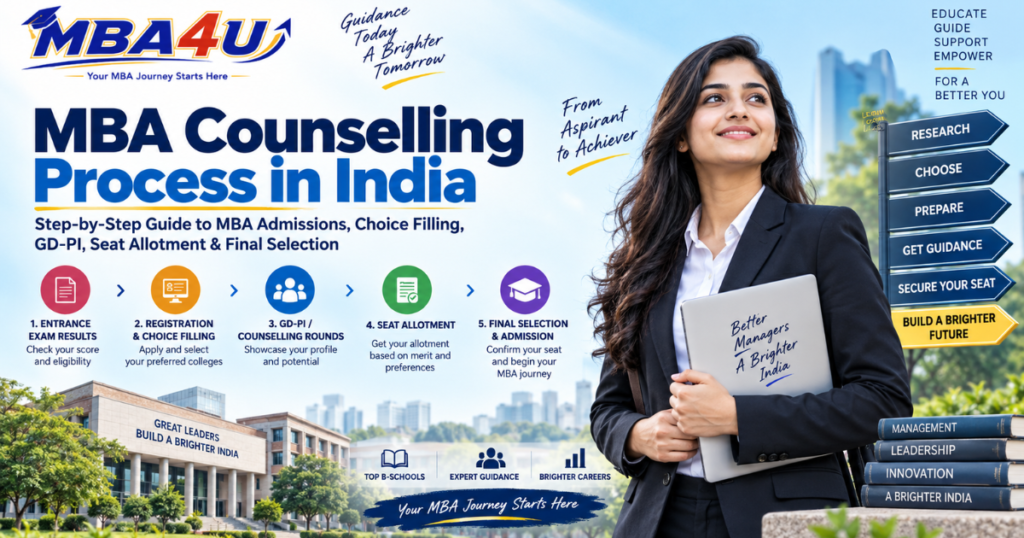
MBA Counselling Process in India 2026: Step-by-Step Admission Guide
Getting a good score in CAT, XAT, CMAT, MAH MBA CET, TANCET, OJEE or another management entrance examination is only one part of the MBA admission journey. The next stage can be equally important: converting that score into an actual MBA or PGDM admission.
This stage is commonly referred to as MBA counselling, but the term can be slightly misleading because MBA admissions in India do not follow one common counselling system.
Some states conduct a formal Centralised Admission Process (CAP), online counselling or seat-allotment process. Many IIMs and leading autonomous B-schools, however, shortlist candidates independently and conduct Written Ability Tests, Personal Interviews, Group Discussions or other assessment rounds before releasing admission offers.
For example, Maharashtra operates a Centralized Admission Process for MBA/MMS admissions, while Odisha conducts web-based counselling for MBA seats through OJEE. Tamil Nadu follows a separate MBA admission and counselling process after TANCET.
At institutions such as IIM Bangalore, the process is very different. Candidates are shortlisted using CAT scores and other academic/profile parameters, followed by further evaluation such as Personal Interview and Written Ability Test before final admission offers are made.
So, if you are searching for the MBA counselling process in India, the first thing to understand is this:
Your admission procedure depends on the entrance examination you have taken, the state in which you are seeking admission and the particular institutes you are targeting.
This guide explains the entire process step by step.
What Is MBA Counselling?
MBA counselling is the broad admission stage through which eligible candidates move from an entrance examination score or shortlist to final admission in an MBA, MMS, PGDM or related management programme.
Depending on the admission authority, counselling can include:
- Online registration
- Uploading academic and category documents
- Document verification
- Publication of merit lists
- Choice filling or preference submission
- College and programme selection
- Seat allotment
- Seat acceptance
- Payment of admission or acceptance fees
- Reporting to the allotted institute
For many autonomous B-schools, the equivalent process may instead include:
- Application to the institute
- Entrance score screening
- Candidate shortlisting
- Written Ability Test
- Group Discussion
- Personal Interview
- Evaluation of academic record
- Work-experience assessment
- Final merit list
- Admission offer
- Waitlist movement
- Fee payment and document verification
Therefore, students should not assume that receiving a CAT, CMAT or state MBA entrance score automatically registers them for every college accepting that examination.
Is There Centralised MBA Counselling in India?
There is no single national counselling portal covering all MBA colleges in India.
This is one of the most important differences between MBA admissions and certain other professional admission systems.
Broadly, MBA admission can be divided into three models.
1. Institute-Level MBA Selection
IIMs and many leading autonomous or private B-schools conduct their own admission process.
The entrance examination may only be the first screening stage.
For instance, IIM Bangalore’s PGP admission process considers CAT performance along with academic performance and other profile parameters for shortlisting. Shortlisted candidates proceed to further assessment involving a Personal Interview and Written Ability Test. Final selection uses multiple components rather than CAT score alone.
Similarly, IIFT states for its MBA (International Business) and MBA (Business Analytics) admission process that CAT scores and other defined parameters are used for shortlisting, after which shortlisted candidates proceed to further selection rounds including GD and PI.
XLRI follows its own process for programmes linked to XAT. For the 2027 admission cycle, XLRI states that shortlisted candidates move to the interview stage, with the exact selection process depending on the programme.
This is not normally called centralised counselling.
2. State-Level Centralised MBA Counselling
Several states operate an organised counselling or CAP process for MBA seats in participating colleges.
Examples include:
Maharashtra MBA/MMS CAP
The Maharashtra State Common Entrance Test Cell operates the Centralized Admission Process (CAP) for MBA/MMS programmes.
For the 2026–27 academic year, the CET Cell listed MBA/MMS under its postgraduate CAP courses and opened the MBA/MMS admission registration process during the admission cycle.
Candidates generally need to complete the prescribed registration, document verification and preference/allotment stages notified for that year’s CAP.
Always check the current year’s CAP brochure because eligibility, accepted examinations, seat categories, timelines and procedural rules may change.
Odisha OJEE MBA Counselling
Odisha Joint Entrance Examination operates admission and eCounselling services and publishes separate counselling schedules for MBA and related postgraduate programmes.
For 2026, OJEE published a web-based counselling schedule covering MBA, MCA, M.Tech, M.Arch, M.Plan and certain other postgraduate programmes. The candidate portal also provided MBA counselling registration.
Tamil Nadu MBA Counselling
TANCET is conducted by Anna University, but students should understand that appearing for TANCET and participating in MBA admission are separate steps.
The official TANCET 2026 information specifically explained that MBA admission involved appearing for TANCET and then applying separately to the concerned admitting authority. The MBA/MCA counselling process is handled separately through Tamil Nadu MBA/MCA Admissions.
Chhattisgarh MBA Counselling
The Chhattisgarh Directorate of Technical Education also operates eCounselling for MBA admissions. Its 2026 schedule included counselling for MBA along with MCA, M.Tech and certain other technical programmes.
These examples show why candidates must identify the correct counselling authority for the state and colleges they are targeting.
MBA Counselling Process in India: Step-by-Step
Although individual procedures differ, most centralised MBA counselling systems broadly follow the stages below.
Step 1: Check Your Entrance Examination Result
The process starts after the relevant MBA entrance test result or scorecard becomes available.
Depending on your target institutions, your examination could include:
- CAT
- XAT
- CMAT
- MAT
- ATMA
- NMAT
- SNAP
- MAH MBA/MMS CET
- TANCET
- OJEE
- KMAT
- AP ICET
- TG ICET
- Karnataka PGCET
- University-specific entrance examinations
Do not immediately assume that every college accepting an examination follows the same counselling system.
Make a list of your target institutions and identify their individual admission route.
Step 2: Check Eligibility Before Registering
A valid entrance-test score does not necessarily mean that you are eligible for every MBA programme accepting that examination.
Check:
- Bachelor’s degree requirement
- Minimum qualifying marks, where applicable
- Final-year student provisions
- Accepted entrance examination
- Domicile requirements, if applicable
- Category requirements
- Work-experience requirement for executive programmes
- Programme-specific conditions
Eligibility rules can differ significantly between states and institutions.
For example, executive MBA or management programmes designed for experienced professionals may prescribe minimum work experience, whereas conventional two-year MBA programmes usually follow different requirements.
Never rely only on an admission advertisement or social-media post. Verify eligibility using the official admission brochure.
Step 3: Register for Counselling or the B-School Admission Process
This is where many students make their first serious mistake.
Entrance-exam registration and counselling registration are often separate.
Taking TANCET, for example, does not by itself complete the Tamil Nadu MBA admission process. The official information for TANCET 2026 specifically described the examination and application to the admitting authorities as separate stages.
Similarly, a CAT score does not mean that you have automatically applied to every B-school that accepts CAT.
Depending on the institute, candidates may have to complete a separate application.
Before the deadline, confirm:
- Have I applied for the entrance examination?
- Have I applied to the college separately?
- Do I need a counselling registration?
- Do I need to complete choice filling?
- Is there a separate application fee?
Maintain a simple spreadsheet containing each college, entrance examination, application deadline, counselling authority and admission status.
It can prevent expensive mistakes.
Step 4: Upload the Required Documents
During counselling registration or institute-level admission, candidates normally have to submit supporting documents.
The exact list varies, but commonly requested documents may include:
| Document | Why It May Be Required |
|---|---|
| Entrance exam scorecard | Verification of examination performance |
| Admit card | Examination identity verification |
| Class 10 certificate | Date of birth/academic verification |
| Class 12 marksheet | Academic verification |
| Graduation marksheets | Eligibility verification |
| Graduation degree/provisional certificate | Proof of qualifying degree |
| Category certificate | Reservation eligibility, where applicable |
| EWS/OBC-NCL certificate | Category claim, subject to applicable rules |
| PwD certificate | Disability-category verification |
| Domicile certificate | State quota eligibility where applicable |
| Work-experience documents | Required by programmes considering experience |
| Government-issued photo ID | Identity verification |
| Passport-size photographs | Admission documentation |
| Migration/transfer certificate | May be required during institute reporting |
This list is indicative, not universal.
Always follow the document list published by the relevant counselling authority or institution.
Step 5: Document Verification
Centralised counselling usually involves verification of the information entered during registration.
Depending on the system, verification may take place:
- Fully online
- At designated verification or scrutiny centres
- Through an institute
- Through a combination of online verification and physical reporting
The purpose is straightforward: the admission authority needs to confirm that the candidate actually satisfies the eligibility and category conditions claimed in the application.
A small mismatch can cause problems.
For example, your name should ideally appear consistently across your entrance scorecard, degree documents and identity records. If there is a genuine discrepancy, keep the appropriate supporting affidavit, certificate or correction documentation prescribed by the authority.
Do not upload altered or misleading documents. Admission can be cancelled if eligibility claims cannot later be supported.
Step 6: Provisional Merit List
In many state-level counselling systems, eligible candidates are placed on a provisional merit list after registration and verification.
The merit calculation may depend on factors such as:
- Entrance-test score
- State or national merit
- Category
- Domicile status
- Qualifying examination
- Admission rules prescribed by the authority
Candidates should carefully check:
- Name
- Category
- Merit number
- Gender
- Domicile status
- Entrance score
- Reservation claim
If the counselling system provides a grievance or correction period, use it immediately if something is incorrect.
Do not wait until seat allotment to raise an issue that could have been corrected during the provisional-merit stage.
Step 7: Final Merit List
After grievance resolution, the admission authority may release a final merit list.
This merit position becomes important because allotments are normally linked to:
Merit position + category + seat availability + preferences submitted by the candidate.
A high merit number alone does not determine which college you will receive. Your choice-filling strategy can significantly influence the allotment.
Step 8: Choice Filling — One of the Most Important Stages
Choice filling means arranging colleges and programmes in your genuine order of preference.
This deserves careful attention.
Suppose a student has the following realistic preferences:
- College A
- College B
- College C
- College D
- College E
The student should generally submit them in that actual preference order rather than trying to guess which institution is “most likely” to be allotted.
Why?
Seat-allotment systems usually consider available choices according to merit and preference rules specified for that particular counselling process.
A poor preference list can lead to a less suitable allotment even when a better option might have been accessible.
How to Build Your MBA College Preference List
Do not choose colleges only by brand name.
Compare them using factors such as:
Programme quality
Check whether the programme fits your intended career direction.
Someone interested in operations and supply-chain careers may evaluate colleges differently from a candidate targeting finance, analytics or marketing.
Total cost
Consider more than tuition fees.
Include:
- Tuition
- Hostel
- Mess
- Deposits
- Other institutional fees
- Living costs
- Travel
- Laptop and academic expenses
Placement evidence
Use the institution’s latest official placement report wherever available.
Look beyond the highest salary.
Useful indicators include:
- Median salary
- Average salary
- Role distribution
- Sector distribution
- Recruiting companies
- Batch size
- Placement report methodology
A high advertised package earned by one student tells you very little about what is realistic for the majority of the batch.
Location
A college’s location can influence:
- Living expenses
- Corporate exposure
- Internship opportunities
- Accessibility
- Industry interaction
But location alone should not override programme quality and career outcomes.
Specialisation and electives
A college may be strong overall but may not offer the depth you want in a particular field.
Review the curriculum.
Return on Investment
ROI should not be reduced to:
Average salary ÷ course fee.
A more sensible decision also considers:
- Total borrowing
- Interest costs
- Opportunity cost
- Programme duration
- Career mobility
- Placement consistency
- Industry access
Step 9: Seat Allotment
After choice filling closes, the authority processes seat allotment according to the applicable rules.
A candidate may receive a seat based on factors such as:
- Merit
- Category
- Reservation rules
- Seat matrix
- Preference order
- Institutional eligibility
The exact mechanism differs by counselling authority.
Do not assume that the rules used in Maharashtra CAP will be identical to Odisha, Tamil Nadu, Chhattisgarh or another state.
Always download the current counselling brochure.
Step 10: Understand Freeze, Float, Upgrade or Similar Options
Some counselling systems provide candidates with options that broadly correspond to concepts such as:
Freeze
You are satisfied with the allotted seat and do not want further upgradation.
Float/Upgrade
You accept the current seat provisionally but want to be considered for a higher preference in subsequent rounds.
Reject/Withdraw
You do not want the allotted seat.
The actual terminology and consequences differ between counselling systems.
Never click an option simply because another student tells you what it means.
Read the official counselling instructions first, because accepting or rejecting a particular option may affect eligibility for subsequent rounds.
Step 11: Pay the Seat Acceptance Fee
Once a seat is allotted, candidates may have to pay a seat-acceptance or admission fee within a specified deadline.
Missing the payment deadline can result in loss of the allotment.
Before paying:
- Confirm the payment is being made on the official portal.
- Check the amount carefully.
- Read refund rules.
- Save the payment receipt.
- Download the allotment letter.
- Keep screenshots or transaction details if necessary.
Avoid making admission payments through unofficial agents.
Step 12: Participate in Further Counselling Rounds
Not getting your preferred college in Round 1 does not necessarily mean the process is over.
Depending on the system, there may be:
- Round 1
- Round 2
- Round 3
- Additional rounds
- Spot round
- Institute-level round
- Vacancy round
For example, Odisha’s 2026 MBA counselling schedule included multiple-round activity, while Chhattisgarh subsequently published additional spot-round schedules for MBA and other programmes.
Vacancies can arise because candidates:
- Upgrade elsewhere
- Withdraw
- Fail to pay fees
- Fail document verification
- Do not report
Therefore, students near the previous closing merit range should continue following official updates.
Step 13: Report to the Allotted College
Once your admission is confirmed, you may have to report to the institution physically or complete the institution’s online reporting process.
The college may re-check original documents before confirming admission.
Carry every document requested in the allotment letter.
Do not assume that successful online document verification eliminates the need to produce originals later.
MBA Admission at IIMs: Why It Is Different From Counselling
Students frequently search for phrases such as “IIM counselling after CAT”.
In practice, IIM admission is generally better understood as an institute-level selection process, not a national counselling system comparable to state CAP allotment.
The broad process may look like:
CAT → IIM shortlist → WAT/PI or institute-specific assessment → composite score → admission offer/waitlist → fee payment
The precise criteria vary by IIM.
For example, IIM Bangalore’s published admission methodology uses multiple parameters during both pre-PI and post-PI selection rather than relying entirely on CAT performance.
Therefore, two candidates with similar CAT percentiles can receive different shortlist or final-admission outcomes because academic profile, work experience and interview-stage performance may also matter.
Does Every MBA College Conduct GD and PI?
No.
The selection process varies widely.
A B-school may use:
- PI only
- GD + PI
- WAT + PI
- GD + WAT + PI
- Extempore
- Essay writing
- Case discussion
- Psychometric assessment
- Profile-based assessment
IIFT’s 2026 admission brochure, for example, stated that shortlisted candidates for its MBA programmes would proceed to a second-round process involving Group Discussion and Personal Interview.
XLRI’s published XAT admission information also describes a separate interview process for shortlisted candidates.
Always check the admission process of the particular programme rather than assuming a standard GD-PI formula.
How to Prepare for MBA Personal Interviews
Once shortlisted, preparation should move beyond entrance-test mathematics and verbal ability.
Interview panels commonly want to understand:
- Why you want an MBA
- Why you want that particular programme
- What you learned during graduation
- Your professional experience
- Your career direction
- Awareness of current business developments
- Your ability to think logically
- Whether your claims are consistent with your application
A working professional should be prepared to discuss actual work responsibilities rather than only designation and company name.
A fresher should be comfortable discussing academic subjects, internships, projects, extracurricular activities and reasons for pursuing management education.
Avoid memorising artificial answers such as:
“I want an MBA because I want to become a successful manager and contribute to society.”
Instead, explain the genuine gap between where you are now and what management education can realistically help you achieve.
How Does an MBA Waitlist Work?
Leading MBA programmes commonly release waitlists because not every selected candidate accepts the offer.
Suppose a college offers 300 seats but expects some admitted candidates to choose other institutions. It may maintain a waitlist and release additional offers as seats become available.
Waitlist movement can vary substantially from year to year depending on:
- Candidate overlap between institutions
- Number of initial offers
- Programme popularity
- Seat intake
- Category
- Admission deadlines elsewhere
Never treat last year’s waitlist movement as a guarantee for the current year.
Use historical movement only as an indicative reference.
Common MBA Counselling Mistakes to Avoid
Registering for the entrance exam but not counselling
This is surprisingly common.
Students receive their score and wait for a college allotment without realising that a separate counselling application was required.
Missing separate B-school applications
CAT, XAT or CMAT registration does not automatically register you for every participating institution.
Check each target college individually.
Filling too few college preferences
Students sometimes enter only two or three ambitious colleges and leave safer options out.
Build a properly researched preference list.
Choosing entirely by average package
A salary number without context can be misleading.
Evaluate fees, batch size, placement consistency, sector mix and roles.
Uploading the wrong category certificate
Reservation certificates may have prescribed formats, dates or issuing-authority requirements.
Follow the counselling brochure exactly.
Ignoring deadlines after allotment
An allotted seat can be lost if acceptance or reporting deadlines are missed.
Depending on agents instead of official portals
For application deadlines, allotments and admission instructions, use the official examination, counselling and institution websites.
Important MBA Counselling Routes Students Should Know
| Admission Route | Typical MBA Admission Model | What Students Should Watch |
|---|---|---|
| CAT / IIM admissions | Institute-level shortlisting and selection | Individual IIM admission criteria |
| XAT / XLRI | Institute-level selection | Programme application, shortlist and interview |
| IIFT MBA | CAT-based institute selection | Application, shortlist and selection rounds |
| MAH MBA/MMS CET | Centralized Admission Process | CAP registration, documents, merit list and allotment |
| TANCET MBA | State admission/counselling | Separate counselling application after examination |
| OJEE MBA | Web-based state counselling | Registration, schedule, choice/allotment stages |
| Chhattisgarh MBA admission | State eCounselling | Counselling rounds and vacancy/spot rounds |
| KMAT Kerala | Entrance route used for MBA admissions | College/institution-specific admission requirements |
This table provides a broad admission map rather than a guarantee of the exact procedure for every institution. Rules and participating colleges can change from one academic session to another.
MBA Counselling Timeline: What Usually Happens?
A typical MBA admission journey may look like this:
Entrance registration → Examination → Result → College/counselling registration → Merit/shortlist → GD/WAT/PI or choice filling → Seat/admission offer → Fee payment → Reporting
The exact months vary significantly between examinations.
CAT-linked admissions typically follow one cycle, while many state MBA admission systems begin after their respective entrance-test results.
Do not create one common calendar for every MBA college.
Instead, maintain a personalised admission tracker.
MBA Counselling Checklist
Before participating in counselling, confirm that you have:
- Downloaded your scorecard
- Checked programme eligibility
- Identified the correct admission authority
- Applied separately to relevant institutes where required
- Registered for counselling
- Uploaded valid documents
- Checked the merit list
- Prepared a researched college preference order
- Read seat-allotment rules
- Understood upgrade/freeze options
- Arranged admission funds
- Checked refund rules
- Saved all receipts
- Monitored subsequent counselling rounds
- Checked institute reporting requirements
A good counselling strategy is less about making clever guesses and more about avoiding preventable errors.
How Parents Can Help During MBA Counselling
Parents often become involved during the final college-selection stage, especially when the programme requires a sizeable financial commitment.
The most useful discussion is not simply:
“Which college has the highest package?”
A stronger conversation covers:
- Total programme cost
- Education-loan requirement
- Academic fit
- Location
- Career goals
- Placement profile
- Specialisation availability
- Hostel arrangements
- Financial risk
- Alternative offers
For example, suppose one MBA programme costs significantly more than another but the student wants a niche career in analytics and the more expensive institution offers stronger curriculum depth and relevant recruiters.
The decision should be based on the student’s circumstances rather than on a single ranking or salary figure.
MBA Counselling for Working Professionals
Working professionals should evaluate one additional factor: opportunity cost.
Leaving a ₹6–8 lakh annual job for a two-year MBA involves not only tuition fees but potentially two years of foregone salary.
Therefore, before accepting an MBA offer, estimate:
Programme fees + living expenses + financing cost + salary forgone during study
Then evaluate whether the programme’s academic quality, recruiter profile, career-switch possibilities and long-term fit justify that investment.
This does not mean that every candidate should choose the cheapest MBA.
It means the financial decision should reflect the person’s actual career situation.
Centralised Counselling vs Direct MBA Admission
Another point that creates confusion is direct admission.
In authorised institutional admission systems, some colleges may fill specified categories of vacant or institute-level seats according to applicable regulations after centralised rounds.
This should not be confused with agents promising “guaranteed MBA admission” in exchange for unofficial payments.
Before paying any money:
- Verify that the institution officially offers the programme.
- Check the admission procedure on the college website.
- Confirm applicable approval/recognition requirements.
- Request an official fee structure.
- Pay only through authorised channels.
- Obtain a proper institutional receipt.
Never rely on verbal promises regarding placement or admission.
What Should You Do If You Have Multiple MBA Offers?
Receiving multiple offers is a good problem to have, but the decision deserves careful comparison.
Create a table with these factors:
| Factor | College A | College B |
|---|---|---|
| Total programme fee | ||
| Latest official median/average salary | ||
| Programme structure | ||
| Desired specialisation | ||
| Batch size | ||
| Preferred recruiters | ||
| Location | ||
| Hostel/living cost | ||
| Education loan required | ||
| Internship opportunities | ||
| Your career fit |
Do not choose merely because one institution has a slightly higher average placement figure.
Look at where you are likely to fit academically, financially and professionally.
Frequently Asked Questions About MBA Counselling in India
Is MBA counselling compulsory?
Not for every MBA admission.
It depends on the institution and admission route. State-level admissions may involve formal counselling or CAP, while IIMs and autonomous B-schools generally follow their own selection processes.
Is CAT counselling conducted centrally?
There is no single national counselling process through which all CAT-accepting colleges are allotted.
IIMs and other B-schools use their own admission rules.
Do I have to apply separately after CAT?
For many institutions, yes.
Always check the application requirements of each B-school.
Is TANCET registration enough for MBA admission?
No. Official TANCET information for the 2026 admission cycle stated that candidates had to appear for the examination and separately apply to the appropriate admitting authority.
Does Maharashtra have centralised MBA counselling?
Yes. The Maharashtra State CET Cell lists MBA/MMS under its Centralized Admission Process.
Does Odisha conduct MBA counselling?
Yes. OJEE publishes web-based counselling schedules and registration activity for MBA and related programmes.
Can I participate in more than one MBA admission process?
Generally, candidates can pursue multiple admission routes simultaneously provided they satisfy the relevant eligibility and application requirements.
However, once fees are paid, check withdrawal and refund conditions carefully.
Does a high entrance percentile guarantee admission?
No.
Many B-schools use additional parameters such as academics, work experience, writing assessment, interview performance and other profile factors.
Can counselling rules change every year?
Yes.
Schedules, seat matrices, participating institutions, fees, reservation requirements and procedures can change from one admission cycle to another.
Always check the current official admission brochure.
Final Advice: Treat MBA Counselling as Part of Your Admission Strategy
Students often spend months preparing for CAT, XAT, CMAT or state MBA entrance examinations and then give comparatively little attention to the admission stage.
That can be costly.
A good entrance score creates opportunities. It does not automatically convert those opportunities into admission.
Once your result is declared, switch from an exam-preparation mindset to an admission-management mindset.
Track every application deadline. Understand whether your college follows centralised counselling or institute-level admission. Keep documents ready. Research your preference order carefully. Compare the total financial commitment rather than tuition alone. And most importantly, make decisions based on the official admission rules applicable to your particular year.
For the 2026–27 and 2027 admission cycles, procedures, dates, seat matrices, fees and selection criteria mentioned in previous years should be treated as indicative unless the current official authority has confirmed them.
Official sources already demonstrate how different these systems can be: Maharashtra has MBA/MMS CAP, Odisha operates MBA web counselling, Tamil Nadu requires a separate admission process after TANCET, while institutions such as IIM Bangalore use their own multi-stage selection methodology.
The best approach is therefore not to search for one universal “MBA counselling date”. Instead, identify your exam + state + institution + programme, and follow that specific admission route.
Important Note
MBA admission procedures, counselling schedules, fees, seat matrices, cut-offs, reservation rules, programme names and selection criteria can change from year to year.
Students should verify all current information through the relevant examination authority, state counselling portal or institution’s official website before applying or making any payment.
Need help comparing MBA colleges, entrance exams, fees and admission options? Explore MBA4U.in for practical MBA and Integrated MBA guidance, admission alerts, examination updates, college comparisons and decision-making support.