
Discover the essential AI Skills for MBA Students in India, including GenAI, prompting, analytics, Excel, SQL, AI agents and responsible AI for jobs, internships and placements.
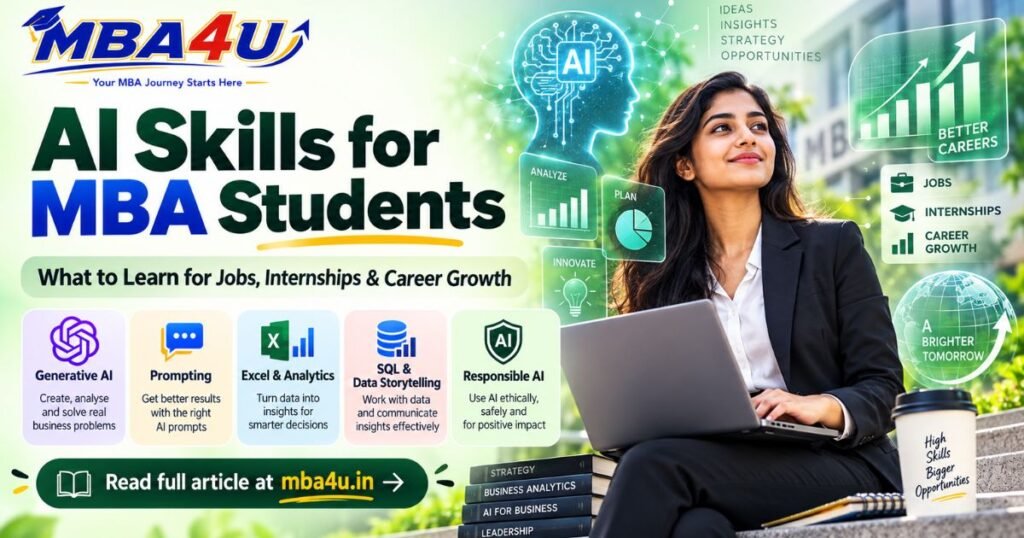
Artificial intelligence is no longer relevant only to software engineers, data scientists or technology companies. Marketing teams use AI to analyse customers and create campaign ideas. Finance professionals use analytical systems for forecasting, risk analysis and reporting. HR teams are experimenting with AI-assisted recruitment and workforce analytics. Operations managers use predictive tools for demand, inventory and supply-chain decisions.
For an MBA student, therefore, the real question is no longer “Should I learn AI?”
A better question is:
“Which AI skills should I learn so that I can become a better manager rather than trying to become a software engineer?”
That distinction matters.
Most MBA students do not need to build large language models or become experts in advanced machine learning. They need enough AI literacy to identify business problems, work intelligently with AI tools, analyse information, question outputs, manage AI-enabled projects and make better managerial decisions.
This guide explains the AI Skills for MBA Students that are likely to matter most for internships, placements and early management careers in India.
What Is the Search Intent Behind “AI Skills for MBA Students”?
The dominant intent is informational with strong career intent.
A student searching for this topic usually wants answers to questions such as:
- What AI skills should an MBA student learn?
- Do MBA students need coding for AI?
- Which AI tools are useful for marketing, finance, HR and operations?
- Is prompt engineering enough?
- How can AI skills help during MBA placements?
- What should I mention on my CV?
- Which projects can demonstrate AI capability?
- Will AI replace traditional MBA jobs?
- Should I learn Excel, SQL, Python or machine learning?
- How can I use AI responsibly without becoming dependent on it?
Let us answer these practically.
Why AI Skills Matter for MBA Students
The nature of management work is changing.
The World Economic Forum’s Future of Jobs Report 2025 identifies AI and big data among the fastest-growing skill areas, while analytical thinking, leadership, creative thinking, resilience and technological literacy also remain important. The message for management students is significant: companies are not merely looking for technology skills in isolation; they increasingly need professionals who can combine technology with judgement, communication and business understanding.
LinkedIn’s India-focused Skills on the Rise information for 2026 similarly highlights areas such as AI and automation, prompt engineering, LLMOps and data storytelling alongside stakeholder management, collaboration and leadership.
This is why an MBA graduate who understands only management theory may increasingly find themselves competing against another candidate who can:
- analyse the same problem faster,
- automate repetitive work,
- interrogate data more intelligently,
- create better first drafts,
- summarise customer research,
- build management dashboards,
- evaluate business scenarios,
- and communicate AI-derived insights to decision-makers.
The advantage is not necessarily that the second candidate “knows AI”.
The advantage is that the candidate knows how to combine AI with management thinking.
What Does AI Literacy Actually Mean for an MBA Student?
AI literacy does not mean knowing every algorithm behind artificial intelligence.
For a management student, AI literacy can be understood through five practical abilities:
- Understanding what AI can and cannot reasonably do.
- Knowing how to interact effectively with AI systems.
- Applying AI to genuine business problems.
- Checking AI-generated information rather than accepting it blindly.
- Understanding ethical, privacy, security and governance implications.
Think about an MBA marketing student analysing a new product launch.
An AI-illiterate approach may be:
“Give me a marketing strategy for this product.”
A more capable student may provide the AI system with:
- target customer,
- price range,
- geographic market,
- competitors,
- positioning,
- channel limitations,
- business objective,
- budget assumptions,
- customer research,
- and desired output format.
The student may then challenge the assumptions, validate data independently and convert the output into a realistic strategy.
That is a much more useful form of AI literacy.
12 Important AI Skills for MBA Students
1. Generative AI Literacy
Start with understanding generative AI itself.
MBA students should know basic concepts such as:
- generative AI,
- large language models or LLMs,
- training data,
- prompts,
- context,
- hallucinations,
- multimodal AI,
- AI agents,
- retrieval-augmented generation or RAG,
- automation,
- and human-in-the-loop decision-making.
You do not initially need the mathematical details behind transformer architectures.
You should, however, understand why an AI system can produce a fluent answer that is still factually wrong.
This is particularly important in management education because students often work with:
- market size estimates,
- financial information,
- company performance,
- legal or regulatory questions,
- academic assignments,
- competitor analysis,
- and strategic recommendations.
A professionally worded AI answer is not automatically a verified answer.
2. Prompt Design and Prompt Engineering
Prompt engineering receives a great deal of attention, but MBA students should treat it as one part of a broader AI skill set.
Useful prompting involves providing:
Role + Context + Objective + Constraints + Data + Output Format + Evaluation Criteria
For example, instead of asking:
“Analyse this company.”
you might ask an AI system to:
“Act as a strategy analyst. Analyse the attached annual report from the perspective of an MBA student preparing a competitive strategy presentation. Identify revenue drivers, margin pressures, customer concentration risks, competitive advantages and strategic risks. Separate facts stated in the report from your interpretation. Do not invent missing numbers. Present the final answer as a management brief followed by five questions that require further research.”
That prompt gives the system a far clearer task.
MBA students should practise:
- zero-shot prompting,
- example-based prompting,
- structured prompting,
- iterative prompting,
- critique-and-revision prompting,
- extracting structured information,
- comparison prompts,
- scenario prompts,
- and prompts that explicitly request uncertainty or verification.
The goal is not to memorise magical prompt formulas.
It is to learn how to communicate business requirements precisely.
3. AI-Assisted Research and Verification
Research may become one of the most useful AI capabilities for management students.
You may use AI while working on:
- industry analysis,
- company profiles,
- competitor comparisons,
- consumer trends,
- internship preparation,
- case competitions,
- presentations,
- consulting projects,
- or placement interviews.
But AI-generated research needs verification.
For example, suppose an AI tool tells you that a company generated ₹8,000 crore in revenue during a particular financial year.
Before putting that number in your presentation, verify it against sources such as:
- the company’s annual report,
- investor relations website,
- stock-exchange filing,
- regulator,
- government database,
- or another authoritative primary source.
An MBA student who merely collects information is useful.
A student who can distinguish reliable evidence from plausible-sounding content is much more valuable.
4. Data Analysis and Data Interpretation
MBA students increasingly need to become comfortable with data.
That does not necessarily mean becoming data scientists.
At minimum, you should be able to understand:
- averages,
- percentages,
- growth rates,
- CAGR,
- correlations,
- distributions,
- trends,
- segmentation,
- forecasting assumptions,
- variance,
- and basic probability.
You should also understand when a chart is misleading or when two variables moving together do not prove that one caused the other.
AI tools can help you analyse data, but managerial judgement remains necessary.
Suppose sales dropped 12%.
An AI system may identify:
- geography,
- channel,
- product category,
- seasonality,
- pricing,
- competition,
- or supply shortages
as possible explanations.
But someone still needs to determine which explanation is supported by actual evidence.
That is where an MBA student’s business knowledge becomes important.
5. Excel and AI-Assisted Spreadsheet Skills
Do not abandon Excel because AI exists.
For many MBA students, Excel remains one of the most practical tools they can learn.
Combine conventional Excel skills with AI-assisted workflows.
Useful areas include:
- PivotTables,
- XLOOKUP or equivalent lookup functions,
- SUMIFS,
- IF statements,
- financial models,
- sensitivity analysis,
- charts,
- dashboards,
- data cleaning,
- forecasting,
- and scenario analysis.
AI systems can help explain formulas, debug calculations, suggest model structures and help analyse spreadsheet data.
However, always check formulas before relying on the output.
For finance, consulting, operations and analyst roles in particular, strong spreadsheet fundamentals are still extremely useful.
6. SQL and Business Data Querying
SQL is worth considering if you want roles involving:
- business analytics,
- product management,
- consulting,
- digital marketing,
- financial analytics,
- operations,
- e-commerce,
- or business intelligence.
SQL allows you to retrieve information from structured databases.
An MBA student does not necessarily need advanced database administration.
Knowing how to work with concepts such as:
- SELECT,
- WHERE,
- GROUP BY,
- ORDER BY,
- JOIN,
- aggregation,
- and basic subqueries
can already make you more comfortable working with organisational data.
AI coding assistants can make SQL easier to learn because they can explain queries and generate drafts.
But you should still understand what the query is doing before using the result.
7. Data Visualisation and Data Storytelling
Managers rarely get rewarded simply for producing more data.
They are expected to explain what the data means.
Imagine two students present identical sales data.
Student A shows ten complicated charts.
Student B says:
“Overall revenue increased, but the growth is being driven almost entirely by two markets. Customer acquisition costs have risen elsewhere, so expanding the same strategy nationally may reduce profitability.”
Student B is providing a management insight.
This is data storytelling.
MBA students should learn to turn analysis into:
- executive summaries,
- dashboards,
- management presentations,
- recommendation slides,
- decision memos,
- and concise explanations.
LinkedIn’s India-focused 2026 Skills on the Rise coverage specifically identifies data storytelling among emerging skills being prioritised by professionals.
8. AI Automation and Workflow Design
One level above using individual AI prompts is designing workflows.
For example, imagine a sales organisation receives hundreds of customer enquiries.
An AI-enabled workflow could potentially:
- capture enquiries,
- classify customer intent,
- extract key information,
- prioritise high-intent prospects,
- generate a draft response,
- update the CRM,
- notify the appropriate salesperson,
- create a weekly management summary.
The MBA graduate does not necessarily have to write every line of code.
But a future manager should increasingly understand:
- what should be automated,
- what should remain with humans,
- where approval is necessary,
- what data the system needs,
- what could go wrong,
- and how business value should be measured.
This is particularly relevant because management institutions themselves are expanding business-oriented AI training. IIM Ahmedabad’s Executive Programme in AI for Business includes generative AI, LLMs, AI agents, automation, business value, customer experience, financial performance, operational efficiency and AI-related risks.
IIM Bangalore has likewise listed executive programmes covering Generative AI, Agentic AI and business applications, including applications across finance, marketing, customer service and operational decision-making.
These are useful signals about where managerial AI capability is heading.
9. AI Agents
AI agents are becoming an important concept for management students to understand.
A conventional generative AI tool may answer a question.
An AI agent can potentially work through multiple steps toward an objective, use tools or data sources, and take certain permitted actions.
From an MBA perspective, you should understand potential applications such as:
- market research agents,
- sales-support agents,
- procurement assistants,
- customer-service workflows,
- recruitment support,
- management reporting,
- financial analysis,
- competitor monitoring,
- and project coordination.
You do not initially need to build sophisticated autonomous systems.
Start by understanding agentic workflows and their business implications.
Also recognise that the more actions an AI system can perform, the more important controls, permissions and governance become.
10. Responsible AI, Ethics and Governance
This is one of the most underestimated AI skills for management students.
Imagine an organisation uses AI for recruitment.
Questions immediately arise:
- Could the model discriminate against candidates?
- What applicant information is being processed?
- Where is that information stored?
- Can the recommendation be explained?
- Who takes responsibility if the system makes a poor recommendation?
- Does a human review the decision?
- Can candidates challenge the outcome?
These are management questions as much as technical questions.
NITI Aayog’s framework on Responsible AI identifies principles including safety and reliability, equality, inclusivity and non-discrimination, privacy and security, transparency, accountability and protection of positive human values.
MBA students should therefore learn basic concepts around:
- privacy,
- data confidentiality,
- bias,
- explainability,
- intellectual property,
- security,
- human oversight,
- accountability,
- and AI governance.
Never paste confidential employer, customer or proprietary information into an external AI tool unless your organisation’s policies explicitly permit it.
11. Critical Thinking and AI Output Evaluation
Ironically, widespread AI use makes human judgement more—not less—important.
Suppose an AI system recommends entering a new geographic market.
A capable manager should ask:
- Which assumptions produced this conclusion?
- Which evidence supports it?
- What evidence contradicts it?
- What information is missing?
- Are regulatory factors included?
- Is the market-size estimate reliable?
- What is the downside scenario?
- What would change the recommendation?
Students should train themselves to challenge AI outputs.
One useful technique is asking:
“What would make this recommendation wrong?”
Another is:
“List the assumptions on which this analysis depends.”
Then verify those assumptions independently.
AI can produce analysis.
Management requires judgement.
12. AI-Assisted Communication
MBA graduates spend considerable time communicating.
You may prepare:
- emails,
- reports,
- proposals,
- meeting notes,
- presentations,
- sales documents,
- strategy papers,
- recruitment communication,
- marketing content,
- and management updates.
AI can accelerate first drafts.
But a student should learn how to edit those drafts for:
- accuracy,
- brevity,
- context,
- tone,
- originality,
- cultural sensitivity,
- and business purpose.
A manager who sends a polished but incorrect AI-generated email is not demonstrating AI competence.
The real skill is AI-assisted communication combined with human editorial judgement.
AI Skills for MBA Students by Specialisation
Different MBA specialisations require different combinations of AI skills.
| MBA Specialisation | Useful AI Skills |
|---|---|
| Marketing | Customer segmentation, content ideation, campaign analytics, consumer research, personalisation, sentiment analysis |
| Finance | Financial modelling, forecasting, data analysis, anomaly identification, research assistance, scenario modelling |
| HR | Recruitment analytics, workforce planning, employee data analysis, learning support, responsible AI in hiring |
| Operations | Demand forecasting, inventory analysis, optimisation concepts, process automation, supply-chain analytics |
| Business Analytics | SQL, Excel, Python basics, statistical analysis, visualisation, machine learning concepts, GenAI |
| Consulting | AI-assisted research, market analysis, data storytelling, scenario analysis, presentation creation |
| Product Management | Customer research, experimentation, product analytics, AI product concepts, agentic workflows |
| International Business | Market research, competitor intelligence, translation support, geopolitical scenario analysis |
| Entrepreneurship | Market validation, customer discovery, prototypes, process automation, financial planning, marketing |
| Healthcare Management | Operational analytics, responsible AI, healthcare data governance, workflow automation |
| Digital Marketing | Content workflows, marketing automation, analytics, personalisation, SEO research, campaign optimisation |
Students should not treat this table as a fixed curriculum. Required skills differ by employer and job profile.
Do MBA Students Need to Learn Python?
Not every MBA student needs Python.
Your decision should depend on your target career.
Python is more useful if you want:
- business analytics,
- advanced finance analytics,
- product analytics,
- data-oriented consulting,
- operations analytics,
- fintech,
- risk analytics,
- or technology-focused management roles.
Python may be lower priority if your target is primarily:
- general sales,
- brand management,
- HR generalist roles,
- relationship management,
- traditional business development,
- or non-analytical management positions.
Even in these roles, AI literacy remains useful.
A sensible progression for many MBA students is:
Excel → Data Analysis → AI Tools → SQL → Visualisation → Python if required
Do not learn Python simply because someone told you that every MBA graduate must know it.
Learn it when it supports your career direction.
Is Prompt Engineering Enough?
No.
Prompt engineering is useful, but the ability to type sophisticated prompts cannot substitute for business knowledge.
Consider a finance student.
Without understanding:
- balance sheets,
- cash flow,
- valuation,
- profitability,
- working capital,
- or financial ratios,
even excellent prompting will not make that student a strong financial analyst.
Likewise, an MBA marketing student still needs to understand:
- segmentation,
- targeting,
- positioning,
- consumer behaviour,
- pricing,
- distribution,
- branding,
- and marketing metrics.
AI amplifies domain knowledge.
It does not eliminate the need for it.
A Practical AI Learning Roadmap for MBA Students
You do not have to learn everything simultaneously.
Stage 1: AI Foundation
Learn:
- how generative AI works conceptually,
- what LLMs are,
- what hallucinations are,
- limitations of AI,
- privacy basics,
- prompt fundamentals.
Suggested duration: approximately 1–2 weeks depending on your existing familiarity.
Stage 2: Everyday MBA Productivity
Practise AI for:
- summarising long documents,
- creating research frameworks,
- analysing case studies,
- brainstorming hypotheses,
- improving presentations,
- preparing interview questions,
- explaining difficult concepts.
Do not submit AI output directly as academic work where institutional rules prohibit it.
Stage 3: Data Skills
Strengthen:
- Excel,
- statistics,
- basic data cleaning,
- visualisation,
- data interpretation.
Then consider SQL.
Stage 4: Specialisation-Specific AI
Choose projects related to your MBA specialisation.
A marketing student could analyse customer reviews.
A finance student could build a financial-analysis workflow.
An HR student could study responsible AI in recruitment.
An operations student could create a demand-forecasting dashboard.
Stage 5: Automation and AI Agents
Once your fundamentals are strong, explore:
- workflow automation,
- AI agents,
- APIs at a conceptual level,
- business process redesign,
- human approval mechanisms.
Stage 6: Build a Portfolio
Do not merely collect certificates.
Build evidence.
A good MBA AI portfolio may contain three to five practical projects.
Five AI Projects MBA Students Can Build
Project 1: AI-Assisted Competitor Analysis
Choose an industry such as:
- food delivery,
- private banking,
- electric vehicles,
- online education,
- insurance,
- consumer electronics.
Compare three companies using publicly verifiable information.
Produce:
- competitor matrix,
- customer positioning,
- financial indicators where publicly available,
- strategic risks,
- growth opportunities.
Clearly identify which information came from verified sources.
Project 2: Customer Review Analysis
Collect a legitimate sample of publicly available customer feedback.
Analyse:
- recurring complaints,
- positive themes,
- feature requests,
- sentiment,
- customer segments.
Then recommend managerial actions.
Project 3: Sales Dashboard
Build an illustrative dataset containing:
- product,
- geography,
- salesperson,
- revenue,
- units,
- margin,
- date.
Create a dashboard showing:
- growth,
- product performance,
- regional performance,
- profitability,
- anomalies.
Add a one-page management recommendation.
Project 4: Recruitment Analytics Case
Design an illustrative hiring process.
Evaluate where AI could assist in:
- resume screening,
- interview scheduling,
- candidate communication,
- skill matching.
Then identify risks relating to:
- bias,
- privacy,
- explainability,
- human oversight.
This shows that you understand both productivity and governance.
Project 5: AI Workflow for a Small Business
Imagine a small Indian business receiving enquiries through its website and social channels.
Design a workflow covering:
Lead received → classified → CRM updated → draft response generated → salesperson notified → weekly dashboard produced
Estimate:
- time saved,
- human review points,
- required data,
- risks,
- success metrics.
This type of project demonstrates managerial thinking rather than merely tool usage.
How to Mention AI Skills on an MBA Resume
Avoid vague statements such as:
“Expert in Artificial Intelligence.”
unless you genuinely possess advanced technical expertise.
Better examples would be:
AI & Analytics: Generative AI workflows, prompt design, Excel analytics, SQL, dashboarding, data storytelling.
Or under a project:
Customer Insights Project: Analysed customer-review data using AI-assisted thematic classification and manual validation; developed actionable recommendations around service quality and customer retention.
Your resume should explain what you accomplished, not merely list software.
How AI Skills Can Help During MBA Placements
Recruiters may not necessarily ask:
“Do you know AI?”
Instead, you may encounter questions such as:
- How would you improve this process using AI?
- What tasks should not be automated?
- How would you evaluate an AI-generated recommendation?
- How could our sales team use generative AI?
- What are the risks of AI in recruitment?
- How would you use customer data responsibly?
- Where could an AI agent improve productivity?
- What business metrics would you track after implementing AI?
This is why conceptual understanding combined with business application matters.
AI Skills vs Traditional MBA Skills: Which Matters More?
This is the wrong either-or comparison.
Strong MBA candidates should combine both.
Traditional management capabilities still matter:
- strategic thinking,
- negotiation,
- communication,
- leadership,
- finance,
- marketing,
- operations,
- consumer understanding,
- decision-making,
- teamwork.
AI adds another layer.
A useful framework is:
Domain Knowledge + Data Skills + AI Literacy + Human Judgement + Communication
That combination is considerably stronger than AI tool knowledge alone.
Common Mistakes MBA Students Make While Learning AI
Collecting too many certificates
Ten certificates with no demonstrable project may have less value than two meaningful projects you can explain confidently.
Ignoring fundamentals
AI cannot compensate for weak finance, marketing, operations or strategy concepts.
Blindly trusting AI answers
Always verify material facts.
Using confidential information
Do not upload sensitive internship, employer, customer or institutional information to external systems without permission.
Learning every new tool
Individual AI products can change rapidly.
Focus on transferable capabilities.
Copying AI-generated content
Recruiters and faculty can often recognise generic output.
Use AI as an assistant, not a substitute for thinking.
Should You Choose an MBA Programme Because It Teaches AI?
AI-related electives can certainly be useful.
For example, IIM Bangalore’s published programme information includes subjects such as Generative Artificial Intelligence, business analytics, data visualisation and storytelling in relevant management curricula, while its executive education portfolio also includes programmes around Generative AI, Agentic AI and AI strategy.
But AI should not be your only criterion for choosing an MBA.
Also evaluate:
- programme quality,
- faculty,
- curriculum,
- accreditation or institutional status,
- peer group,
- internships,
- placement outcomes,
- specialisation depth,
- industry exposure,
- fees,
- location,
- and expected return on investment.
Course structures and electives can change from year to year, so always verify the current curriculum on the institution’s official website.
Can AI Replace MBA Jobs?
Some tasks within MBA-oriented jobs are likely to become increasingly automated or AI-assisted.
That is different from saying that entire categories of management jobs will simply disappear.
Tasks particularly suited to automation may include:
- routine summaries,
- repetitive reporting,
- basic data extraction,
- first-draft content,
- document classification,
- standard research,
- meeting-note preparation.
But managerial work also involves:
- accountability,
- negotiation,
- persuasion,
- ambiguity,
- organisational politics,
- leadership,
- customer relationships,
- judgement,
- ethics,
- trade-offs,
- and responsibility for outcomes.
The better career strategy is therefore not attempting to compete with AI at repetitive tasks.
Learn to use AI while strengthening the capabilities for which human judgement remains central.
What AI Skills Should a Fresher Learn Before Starting MBA?
If you are preparing to join an MBA or Integrated MBA programme, start with these six:
- Generative AI fundamentals
- Prompting
- Excel
- Basic statistics
- Research and source verification
- Presentation and data storytelling
After joining your MBA, add SQL, automation, specialised analytics or Python according to your career goals.
What AI Skills Should Working Professionals Learn Before an Executive MBA?
Working professionals should focus less on individual tools and more on organisational application.
Important areas include:
- AI strategy,
- workflow redesign,
- AI project evaluation,
- data governance,
- responsible AI,
- automation opportunities,
- AI agents,
- change management,
- workforce impact,
- and ROI measurement.
This is consistent with the business-oriented AI topics currently appearing in executive programmes at institutions such as IIM Ahmedabad and IIM Bangalore.
How to Choose an AI Course as an MBA Student
Before paying for any course, ask:
Does it teach business applications?
A management student should understand how AI affects functions and decisions.
Are there practical assignments?
Watching videos alone rarely builds competence.
Does it teach verification?
A responsible course should discuss AI limitations.
Does it cover privacy and ethics?
This should not be treated as an optional topic.
Does it include projects?
Projects provide stronger evidence of capability.
Is the technical depth appropriate?
A programme designed for machine-learning engineers may not be the best use of time for every MBA aspirant.
Who provides the course?
Evaluate the institution, instructor credentials and curriculum rather than relying only on marketing language.
A 90-Day AI Skills Plan for MBA Students
Days 1–15
Learn AI fundamentals, LLM concepts, prompting and responsible AI.
Days 16–30
Use AI for management research, document analysis and presentation preparation.
Days 31–45
Strengthen Excel and basic statistics.
Days 46–60
Learn SQL fundamentals and data visualisation.
Days 61–75
Build one specialisation-specific AI project.
Days 76–90
Build a second project, prepare your portfolio and practise explaining your work during interviews.
The timeline is indicative. Someone with an engineering or analytics background may progress faster; someone without previous data experience may need longer.
Frequently Asked Questions About AI Skills for MBA Students
Which AI skill is most important for MBA students?
AI literacy is the starting point, but its real value comes when combined with domain expertise, data interpretation, critical thinking and communication.
Is coding compulsory for MBA students learning AI?
No. Many managerial AI applications require little or no coding. Python becomes more relevant for analytics-heavy careers.
Should MBA students learn ChatGPT?
Learning how to work effectively with leading generative AI systems can be useful, but students should focus on transferable skills such as prompting, verification and workflow design rather than becoming dependent on one product.
Is prompt engineering a good career skill for MBA students?
Prompting is useful, but it should complement stronger capabilities such as business analysis, data interpretation and domain expertise.
Are AI certificates valuable during MBA placements?
Certificates can demonstrate learning, but projects, internships and your ability to explain practical applications generally provide stronger evidence of competence.
Which MBA specialisation benefits most from AI?
AI is relevant across marketing, finance, HR, operations, analytics, consulting and product management. The appropriate tools and depth differ across specialisations.
Should a non-engineering MBA student learn AI?
Yes. A commerce, arts, science or other non-engineering student can learn business-oriented AI without becoming a programmer.
Can AI help with MBA case competitions?
Yes. AI can help with research frameworks, hypothesis generation, data analysis and presentation refinement. Students should independently verify factual information and comply with competition rules governing AI use.
Will AI replace MBA graduates?
AI may automate individual tasks, but management roles also require judgement, stakeholder management, leadership, accountability and context. The more practical strategy is to learn how to work effectively with AI.
Final Takeaway: Become an AI-Enabled Manager, Not Just an AI User
The strongest AI Skills for MBA Students are not simply knowing how to type prompts into an AI chatbot.
A capable MBA graduate should be able to:
understand a business problem → collect credible information → analyse data → use AI appropriately → challenge the output → communicate the insight → make a responsible recommendation.
That is a far more durable capability.
Begin with AI literacy and prompting. Strengthen Excel and analytical thinking. Learn SQL if your target career requires data. Explore workflow automation and AI agents as you progress. Understand privacy and responsible AI. Most importantly, keep building your core MBA expertise.
Technology will continue changing.
Your ability to understand business problems, evaluate evidence, use technology intelligently and exercise sound judgement is likely to remain much more durable.
Need help comparing MBA colleges, entrance exams, fees and admission options? Explore MBA4U.in for practical MBA and Integrated MBA guidance.