
MBA vs MTech after BTech in India: compare eligibility, CAT vs GATE, fees, salary, careers, ROI, job opportunities and find which postgraduate path suits you.
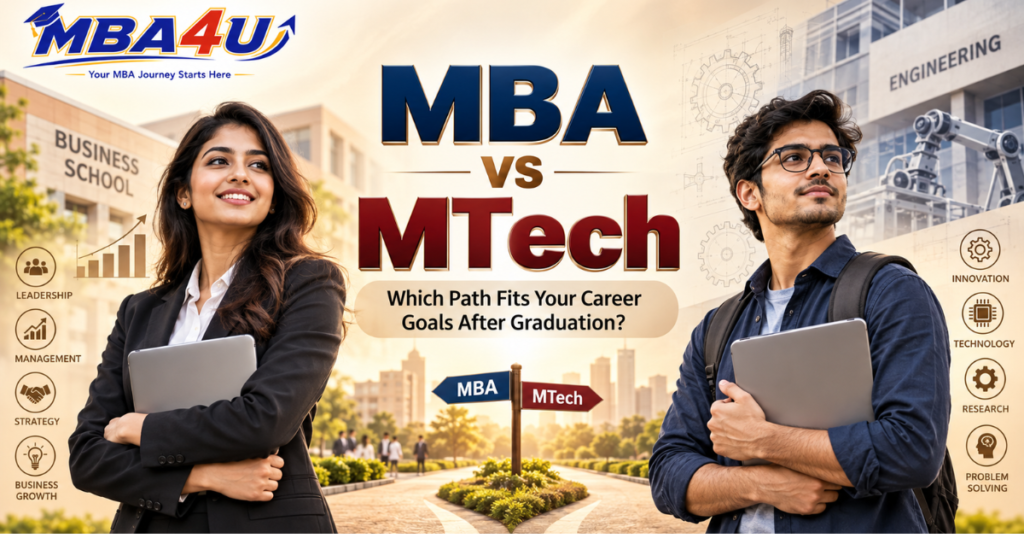
For many engineering graduates, the question appears sooner or later: MBA or MTech—which one should I choose?
At first, it looks like a comparison between two postgraduate degrees. In reality, it is a decision between two quite different career directions.
An MTech usually takes you deeper into technology, engineering, research, design and specialised technical problem-solving. An MBA generally takes you towards management, consulting, finance, marketing, product management, operations, business analytics, strategy or entrepreneurship.
That is why asking simply, “Is MBA better than MTech?” may not give you a useful answer.
A better question is:
What kind of work do I want to be doing five to ten years from now?
A BTech graduate who enjoys coding, chip design, structures, thermal systems or research may find an MTech much more valuable than an MBA. Another engineer who enjoys solving business problems, working with clients, managing teams or understanding markets may find an MBA better aligned with his or her career.
This MBA4U.in guide compares MBA vs MTech after BTech in India across eligibility, entrance exams, fees, curriculum, career scope, salaries, return on investment, job roles and suitability so that you can make the decision based on your own career direction rather than popular opinion.
Data note: Admission criteria, fees, cut-offs, programmes, scholarships and placement figures change periodically. Wherever figures are mentioned, treat them as indicative for the cited admission cycle and verify the latest information on the institution’s official website before applying.
MBA vs MTech: Quick Comparison
| Factor | MBA | MTech |
|---|---|---|
| Full form | Master of Business Administration | Master of Technology |
| Primary focus | Management, business and leadership | Advanced engineering and technology |
| Typical duration | 2 years for a regular full-time MBA | Usually 2 years for a regular full-time MTech |
| Common entrance route | CAT, XAT, CMAT, GMAT and institute-specific processes | GATE and institute-specific selection processes |
| Academic direction | Business-oriented | Technical/research-oriented |
| Suitable for | Students interested in management, consulting, finance, marketing, operations, product, analytics, entrepreneurship | Students interested in engineering specialisation, R&D, technology development, academia and technical roles |
| Prior engineering degree essential? | No | Normally programme-dependent; engineering/science background requirements vary |
| Major career shift possible? | Yes | Usually deepens or redirects technical specialisation |
| Typical learning style | Cases, projects, presentations, group work, quantitative/business analysis | Advanced coursework, laboratories, projects, design, research and technical problem-solving |
| Cost | Can range from relatively inexpensive university programmes to ₹20 lakh+ at premium institutions | Often substantially lower at publicly funded IITs/NITs, though programme/category matters |
| Financial assistance | Scholarships/loans vary by institution | Eligible GATE-based students in some programmes may receive assistantships |
| Typical career outcome | Managerial/business roles | Specialist technical/research roles |
The difference can be summarised simply:
MBA broadens your career towards business. MTech deepens your career towards technology.
But there are several exceptions. Modern careers such as product management, AI strategy, technology consulting and analytics frequently combine both technical and managerial knowledge.
What Is an MBA?
An MBA is a postgraduate management qualification designed to develop understanding of how organisations work.
A typical MBA curriculum may include:
- Finance and accounting
- Marketing
- Operations management
- Human resource management
- Strategy
- Economics
- Organisational behaviour
- Business analytics
- Information systems
- Supply-chain management
- Entrepreneurship
- Communication and leadership
Students subsequently choose electives or specialisations depending on the institution.
Engineering graduates form a significant part of the applicant pool at many management institutes because an engineering education often provides quantitative and problem-solving skills that transfer reasonably well to management education.
However, you should not pursue an MBA merely because many engineers do it.
The degree makes more sense when you genuinely want to move towards business decision-making rather than purely technical execution.
What Is an MTech?
MTech is an advanced postgraduate technical degree.
Instead of moving away from engineering, it generally allows you to specialise further.
Depending on your undergraduate discipline and the institution, examples may include:
- Computer Science and Engineering
- Artificial Intelligence
- Data Science
- VLSI Design
- Microelectronics
- Communication Systems
- Power Systems
- Structural Engineering
- Transportation Engineering
- Thermal Engineering
- Manufacturing
- Robotics
- Aerospace Engineering
- Chemical Engineering
- Materials Engineering
- Environmental Engineering
IIT Madras, for example, describes its regular MTech programmes as four-semester programmes containing core courses, electives and project work.
An MTech can therefore be especially useful when your desired job requires technical depth that a general BTech curriculum may not provide.
MBA vs MTech Eligibility: A Major Difference Students Often Miss
MBA eligibility
MBA programmes generally accept graduates from a wide range of academic disciplines.
Engineering is not compulsory.
Individual business schools set their own minimum academic requirements. For example, FMS Delhi states for its full-time MBA that an eligible candidate must hold a bachelor’s degree after 12 years of schooling with the prescribed minimum marks, with category-specific provisions under University of Delhi rules. Final-year students can also apply subject to fulfilling the eventual admission requirements.
MBA selection may involve some combination of:
CAT/another entrance examination + academic record + work experience + written assessment + interview.
The exact formula varies by institution.
IIM Bangalore, for example, states that domestic PGP admission uses CAT and considers several factors beyond the entrance-test score, including scholastic achievement, work experience and subsequent selection-stage performance.
MTech eligibility
MTech eligibility requires more care.
The official GATE 2027 eligibility rules allow students in the third year or above of several recognised undergraduate programmes—including Engineering, Technology, Science, Commerce, Arts and Humanities—to appear for GATE.
But:
Being eligible to write GATE does not automatically make you eligible for every MTech programme.
The GATE authorities themselves clarify that admission is governed by the eligibility and selection criteria of the individual institution.
For example, an IIT department may prescribe:
- Particular undergraduate branches
- Specific GATE papers
- Minimum CGPA or percentage
- Interviews
- Written tests
- Additional prerequisites
At IIT Delhi’s CSE department, the 2026 full-time MTech selection process was primarily based on the CS GATE score, with specified exemptions/routes for certain IIT/CFTI graduates.
Therefore, never select your GATE paper or MTech target only by looking at the general GATE eligibility page.
First identify the MTech programme you want, then check that department’s admission requirements.
MBA Entrance Exams vs MTech Entrance Exams
Common MBA entrance examinations
Depending on your target institutions, MBA aspirants may encounter:
- CAT
- XAT
- CMAT
- NMAT
- SNAP
- MAT
- GMAT
- State-level examinations
- Institution-specific admission processes
For students targeting IIMs and many other prominent Indian management institutions, CAT is particularly important.
An MBA applicant therefore prepares primarily for aptitude-based testing involving quantitative ability, verbal ability, reading comprehension, logical reasoning and data interpretation rather than advanced undergraduate engineering subjects.
MTech entrance examination
The principal national examination is GATE—Graduate Aptitude Test in Engineering.
GATE 2027 is being organised by IIT Madras on behalf of the National Coordination Board-GATE under the Department of Higher Education, Ministry of Education. The official GATE website states that qualified candidates can use GATE scores for postgraduate and doctoral admissions with possible financial assistance in eligible institutions; some PSUs also use GATE scores for recruitment.
For GATE 2027, the official website states that the score has a validity of three years.
MTech aspirants applying to IITs should also understand COAP.
COAP is primarily an offer-acceptance platform—not the application form for individual institutes. Candidates generally need to apply separately to the institutes in which they want admission.
NITs and several participating CFTIs commonly use CCMT for GATE-based postgraduate counselling. NIT Tiruchirappalli describes CCMT as the centralised platform for MTech/MArch/MPlan admission across participating NITs, IIEST, certain IIITs and CFTIs.
MBA vs MTech Course Fees
This is one of the biggest practical differences.
MBA fees
MBA fees differ enormously.
Consider two examples from the 2026 admission cycle.
IIM Bangalore
IIM Bangalore lists the fee for its domestic PGP 2026–28 batch as ₹26 lakh for two years, excluding specified additional items such as mess advances and applicable taxes.
FMS Delhi
FMS’s MBA 2026–28 information bulletin states an MBA semester fee of approximately ₹60,818 per semester, subject to revision by the University of Delhi.
That difference illustrates why students should never speak of “the MBA fee” as though it were one standard amount.
MTech fees
At publicly funded technical institutions, regular MTech programmes may have a significantly lower direct fee burden.
For IIT Delhi’s 2026 entry batch, the institute prospectus lists MTech tuition of ₹17,500 per semester for students receiving specified institute/project assistantship or teaching positions, while sponsored/non-teaching categories have a different tuition structure. Other institute charges apply in addition.
At IIT Madras, the 2026 admission information listed an institute fee payable at offer acceptance of ₹66,402 for General/EWS/OBC-NCL MTech candidates and ₹41,402 for SC/ST/PwD candidates, with semester fees additionally payable.
These examples are not directly comparable because institutions structure and publish their fees differently.
Always compare the complete cost of attendance, not one fee component.
Can You Get a Stipend During MTech?
This can significantly affect ROI.
For example, IIT Madras states that eligible MTech students under its Half-Time Teaching Assistantship arrangement can receive ₹12,400 per month, subject to institute rules, for a maximum specified period, while performing assigned academic work.
This does not mean every MTech student in India automatically receives ₹12,400.
Assistantship eligibility depends on programme, admission category, GATE qualification, institute regulations and funding.
MBA students generally do not have an equivalent nationwide GATE-linked assistantship system, although business schools may offer scholarships, financial aid and education-loan arrangements.
MBA vs MTech Salary: Which Pays More?
This is probably the most searched question—and also one of the easiest to oversimplify.
There is no meaningful universal answer such as:
MBA salary > MTech salary.
Salary depends on:
- Institution
- Specialisation
- Previous experience
- Industry
- Job function
- Technical skills
- Location
- Economic conditions
- Hiring cycle
- Individual performance
For example, FMS Delhi’s official final placement report for the 2024–26 MBA batch reported an average CTC of ₹32.27 lakh and median CTC of ₹29.59 lakh.
That is an institutional placement outcome—not a salary expectation for every MBA graduate in India.
Similarly, MTech outcomes can vary dramatically between programmes such as Computer Science, VLSI, structural engineering, biotechnology, manufacturing and thermal engineering.
Even within one IIT, different MTech specialisations can face very different recruitment markets.
So instead of asking:
Which degree gives more salary?
Ask:
Which degree gives me access to the roles for which my abilities and interests are strongest?
That is a more useful career question.
MBA vs MTech: Representative Institutions to Explore
The following is not a ranking. It is a practical starting list showing different types of MBA and MTech institutions.
| Name of Institution | Location | Programme Offered | Entrance Exam | Salary | Eligibility | Percentile Cutoff | Approximate Course Fee | Official Website |
|---|---|---|---|---|---|---|---|---|
| IIM Bangalore | Bengaluru | PGP/MBA | CAT | Check latest official placement report | Bachelor’s degree; detailed criteria apply | Changes by admission cycle; CAT is only one component | ₹26 lakh for PGP 2026–28, plus specified additional expenses | IIM Bangalore |
| FMS Delhi | Delhi | MBA Full Time | CAT | 2024–26 average CTC ₹32.27 lakh; median ₹29.59 lakh | Bachelor’s degree with prescribed category-wise minimum requirements | Selection criteria change; check current bulletin | Approx. ₹60,818 semester fee for 2026–28, subject to revision; other charges may apply | FMS Delhi |
| IIT Bombay | Mumbai | MTech/MTech + PhD | GATE; programme-specific routes | Check latest official placement report | Programme/department-specific qualifying degree and requirements | GATE cut-offs are discipline/category/programme-specific | Check current institute fee circular; category-dependent | IIT Bombay MTech Admissions |
| IIT Delhi | New Delhi | MTech | GATE/department-specific routes | Check latest institute/department placement information | Department-specific | Programme/category-specific | 2026 tuition ₹17,500/semester for specified assistantship categories; other charges apply | IIT Delhi |
| IIT Madras | Chennai | MTech | GATE; certain IIT-graduate routes | Check latest official placement information | Programme-specific degree/GATE requirements | Programme/category-specific | 2026 admission-stage institute fee ₹66,402 Gen/EWS/OBC-NCL; semester/other fees extra | IIT Madras MTech Admissions |
| IISc Bengaluru | Bengaluru | Multiple MTech programmes | GATE and programme-specific selection routes | Programme-specific; check official placement information | Varies considerably by programme | Programme/category-specific | Check current official fee circular | IISc Bengaluru |
| NIT Tiruchirappalli | Tiruchirappalli | MTech | GATE/CCMT for applicable programmes | Check latest official placement report | Programme-specific | CCMT programme/category-specific | Check 2026 PG fee notice | NIT Tiruchirappalli MTech Admissions |
Important: Fees, cut-offs, GATE requirements, programmes, placement figures and eligibility conditions can change every admission cycle. Some institutes publish tuition separately from hostel, mess, deposits and other institute charges. Always verify the latest admission brochure and fee notice before applying.
MBA vs MTech Career Options
Careers after MBA
An MBA can lead towards roles such as:
Management consulting
Consultants analyse business problems involving strategy, operations, organisation, technology or transformation.
An engineering background can be useful because many consulting assignments require structured analytical thinking.
Product management
This can be an attractive area for engineers who want to remain close to technology without spending their entire career in coding or engineering design.
Product managers typically coordinate across engineering, design, marketing, sales and business teams.
Finance
Possible roles may include:
- Corporate finance
- Investment banking
- Credit
- Equity research
- Financial planning
- Risk
- Treasury
A finance role requires genuine interest in financial concepts; merely obtaining an MBA does not automatically make an engineer suitable for finance.
Marketing and sales
MBA graduates may work in:
- Brand management
- Sales
- Digital marketing
- Product marketing
- Market research
- Consumer strategy
Operations and supply chain
This is one MBA area where engineering graduates often find significant overlap with their undergraduate problem-solving approach.
Business analytics
Engineers with strong quantitative ability may combine management education with analytics, statistics and data-based decision-making.
General management
Some organisations recruit MBA graduates into management trainee or leadership-development programmes spanning several functions.
Careers After MTech
MTech roles depend much more heavily on specialisation.
Computer Science
Possible areas include:
- Software engineering
- Machine learning
- AI
- Systems
- Algorithms
- Security
- Research engineering
Electronics, VLSI and Microelectronics
Students may target:
- Semiconductor design
- Verification
- Embedded systems
- Chip architecture
- Electronics R&D
Mechanical Engineering
Possible areas include:
- Design engineering
- Simulation
- Manufacturing
- Thermal systems
- Automotive engineering
- R&D
Civil Engineering
Possible specialisations include:
- Structural engineering
- Geotechnical engineering
- Transportation
- Construction technology
- Water resources
- Environmental engineering
Electrical Engineering
Career domains can include:
- Power systems
- Control
- Signal processing
- Communications
- Instrumentation
- Microelectronics
MTech can also provide a pathway towards PhD, teaching and research, depending on the student’s academic plans.
MBA vs MTech for Software Engineers
This deserves a separate discussion because many BTech CSE graduates face this decision.
Consider two software engineers.
Student A
He enjoys:
- Coding
- Algorithms
- AI
- Systems
- Machine learning research
He wants to become a specialist engineer or eventually work in advanced R&D.
An MTech in CSE/AI or a related area may fit his direction better.
Student B
She works as a software engineer but increasingly enjoys:
- Discussing customer requirements
- Prioritising features
- Product strategy
- Market analysis
- Coordinating teams
- Business decision-making
An MBA may make more sense if she wants to move towards product management, consulting or general management.
Neither choice is inherently superior.
The difference is the career destination.
MBA vs MTech for Core Engineering Students
Suppose you are a mechanical engineer.
If you enjoy CAD, modelling, thermal systems, manufacturing, robotics or automotive engineering, leaving the technical path only because “MBA packages are higher” can be a poor decision.
But if your experience during BTech internships has convinced you that you prefer:
- Operations
- Consulting
- Supply-chain management
- Business development
- Strategy
then an MBA deserves serious consideration.
The same principle applies to civil, electrical, chemical and electronics students.
MBA vs MTech After BTech With Work Experience
Work experience can clarify the decision considerably.
Imagine you have worked for three years as a software engineer.
Ask yourself:
What frustrates me about my current role?
If the answer is:
“I want to understand this technology much more deeply.”
MTech could be appropriate.
If the answer is:
“I no longer want my career to remain primarily technical. I want to move into business, product or consulting.”
MBA may offer a better bridge.
This distinction matters because some professionals apply for MBA simply because they want a change.
A change of company is not the same as a change of career direction.
MBA vs MTech ROI
ROI should not be calculated from placement salary alone.
A more sensible calculation includes:
Programme fee + living expenses + financing cost + salary forgone during study
compared with:
expected career opportunities after graduation.
For example, a candidate leaving a ₹12 lakh job to undertake a two-year programme costing ₹25 lakh is making a much larger financial investment than a fresh graduate entering a comparatively low-cost postgraduate programme.
At the same time, ROI cannot be evaluated purely over the first year’s salary.
A degree may create access to career paths whose value becomes clearer over five or ten years.
When Does an MBA Make More Sense?
Consider MBA seriously when several of the following describe you:
- You want to move into management.
- You enjoy solving business rather than purely engineering problems.
- You are interested in consulting.
- You want to explore finance or marketing.
- You want to move into product management.
- You enjoy client interaction.
- You want broad exposure to different business functions.
- You are considering entrepreneurship.
- You want to move from technical execution towards managerial responsibility.
- You are comfortable with presentations, teamwork, communication and ambiguous business problems.
Do not choose an MBA solely because somebody told you:
“Engineers eventually become managers anyway.”
That is not a sufficient reason to invest two years and potentially lakhs of rupees.
When Does an MTech Make More Sense?
Consider MTech seriously when:
- You enjoy your engineering discipline.
- You want deeper technical expertise.
- Your desired career requires a specialisation.
- You enjoy laboratories, research or technical projects.
- You are interested in R&D.
- You may eventually pursue a PhD.
- You want to strengthen your profile for specialised engineering jobs.
- You are interested in academia.
- You prefer technical problem-solving to business-oriented work.
- You can identify a specific MTech specialisation you genuinely want to study.
A strong sign is when you can say:
“I want an MTech in VLSI because I want to work in semiconductor design.”
That is much stronger than:
“I don’t know what to do after BTech, so maybe I’ll prepare for GATE.”
MBA vs MTech: Which Is Harder?
There is no useful universal comparison.
They require different abilities.
MBA entrance preparation may test
- Quantitative aptitude
- Verbal ability
- Reading comprehension
- Logical reasoning
- Data interpretation
- Test-taking strategy
- Interview communication
MTech/GATE preparation may test
- Undergraduate technical fundamentals
- Mathematical ability
- Conceptual depth
- Numerical problem-solving
- Discipline-specific knowledge
A student excellent in electrical engineering may find GATE preparation natural but struggle with CAT verbal ability.
Another engineer may dislike advanced technical subjects yet perform extremely well in aptitude tests and business interviews.
Difficulty is therefore personal.
MBA vs MTech: Can I Do MBA After MTech?
Yes.
An MTech does not prevent you from pursuing an MBA later, subject to the business school’s admission criteria.
This route may make sense for someone who first develops technical depth, works in industry and subsequently wants managerial responsibility.
However, doing both degrees simply to collect qualifications is rarely a sensible use of time and money.
Each degree should solve a specific career problem.
Can I Do MTech After MBA?
Whether you can enter a particular MTech programme depends on your undergraduate qualifications and the programme’s eligibility rules—not merely on possessing an MBA.
A BTech graduate who later completes an MBA may still satisfy the academic background for some MTech programmes, but he or she must check the specific institute’s qualifying-degree and entrance requirements.
MBA or MTech for Government/PSU Careers?
MTech and GATE can be especially relevant for students targeting technical positions.
The official GATE information states that several PSUs use GATE scores for recruitment, although PSU recruitment policies, disciplines, vacancies and eligibility conditions vary from year to year.
An MBA, meanwhile, may be more relevant for management, finance, HR, marketing, operations or administrative career paths.
Students interested specifically in government or PSU recruitment should therefore investigate the actual post and recruitment notification rather than choosing the degree first.
Common Mistakes While Choosing MBA vs MTech
1. Choosing only on the basis of salary
A placement brochure shows what happened to one batch under particular market conditions. It does not guarantee your future salary.
2. Following friends
Your friend may enjoy finance. You may enjoy robotics.
The same postgraduate degree need not suit both of you.
3. Assuming MBA means becoming a CEO
Most MBA graduates begin in defined functional or managerial roles. Leadership develops through experience.
4. Assuming MTech automatically guarantees a core job
An advanced technical degree can strengthen your expertise, but employment outcomes depend on specialisation, skills, institution, market demand and individual performance.
5. Preparing for CAT and GATE without deciding your direction
Some students prepare seriously for both because they cannot decide.
Keeping options open initially is reasonable.
Remaining undecided until admission offers arrive is less sensible.
Study the actual jobs associated with both routes early.
A Practical 7-Question MBA vs MTech Decision Test
Answer these honestly.
1. Would I rather solve a business problem or an engineering problem?
Business → MBA direction
Engineering → MTech direction
2. Do I enjoy my current technical field?
Strong yes → investigate MTech seriously.
3. Which job would I rather have five years from now?
Compare specific roles—not degrees.
For example:
Product Manager vs Machine Learning Engineer.
Management Consultant vs VLSI Design Engineer.
Operations Manager vs Automotive R&D Engineer.
4. Am I moving towards something or merely escaping something?
“I hate my current job” does not automatically mean MBA.
Maybe you need a different company, domain or technical specialisation.
5. Can I justify the financial investment?
Calculate programme cost and opportunity cost.
6. Have I checked actual curricula?
Read the subjects taught by your shortlisted MBA and MTech programmes.
The answer sometimes becomes obvious.
7. Have I spoken to people doing the jobs I want?
Talking to one product manager and one specialist engineer can sometimes teach you more than reading twenty generic “MBA vs MTech” comparisons.
MBA vs MTech: Decision Matrix
| Your Career Goal | Direction Worth Exploring |
|---|---|
| Management consulting | MBA |
| Marketing | MBA |
| Corporate finance | MBA |
| Product management | MBA often relevant; technical experience can also matter |
| Business analytics | MBA/analytics programme or technical postgraduate route depending on desired role |
| Entrepreneurship | MBA can help, but is not compulsory |
| AI/ML engineering | MTech/technical postgraduate route often more aligned |
| Semiconductor/VLSI design | MTech |
| Structural engineering | MTech |
| Advanced mechanical design | MTech |
| Research scientist/technical R&D | MTech, often followed by PhD depending on role |
| University teaching/research | MTech and potentially PhD |
| Operations/supply-chain management | MBA |
| Technology consulting | Either route can be relevant depending on role |
MBA vs MTech: Which Is Better?
There is no universally better degree.
For a student who wants management consulting, an MTech may provide technical depth but may not be the most direct route.
For a student who wants to design semiconductor chips, an MBA would usually take the student further away from the required technical specialisation.
The question therefore should not be:
MBA or MTech—which degree is better?
It should be:
Which degree moves me closer to the work I actually want to do?
Choose MBA if you genuinely want to transition towards management, consulting, finance, marketing, product, operations, analytics or broader business responsibilities.
Choose MTech if you want advanced technical knowledge, specialisation, engineering R&D, research or a stronger foundation for technical doctoral study.
And if you remain undecided, do not rush into either.
Work for a year or two, undertake internships, speak to professionals and understand the job roles first. A postgraduate degree taken with a clear objective is usually much more valuable than one chosen simply because graduation is ending.
Frequently Asked Questions
Is MBA better than MTech after BTech?
Neither is universally better. MBA is generally more suitable for students seeking business and management careers, while MTech is more aligned with advanced technical, engineering and research roles.
Which has a higher salary: MBA or MTech?
There is no standard salary comparison. Compensation depends on institution, specialisation, employer, role, work experience and economic conditions. Avoid choosing either programme solely from headline placement packages.
Can a BTech student do MBA?
Yes. Engineering graduates can apply to MBA programmes provided they satisfy the eligibility and admission requirements of the institution.
Is GATE compulsory for MTech?
GATE is a major route for regular MTech admission at IITs and many other institutions, but exceptions and alternative categories exist. IIT Bombay, for example, states that GATE is the MTech entrance test while also publishing category-specific admission provisions.
Is CAT compulsory for MBA?
No. CAT is used by IIMs and many other institutions, but India has several MBA entrance examinations and some institutions use different admission routes.
Is MTech cheaper than MBA?
At many publicly funded IITs and NITs, regular MTech fees can be considerably lower than fees at premium residential MBA programmes. However, fees vary widely, so compare institutions rather than degrees in isolation.
Can I get a stipend during MTech?
Eligible students in specified programmes/categories may receive assistantships. For example, IIT Madras lists HTTA financial assistance of ₹12,400 per month subject to its rules.
Is work experience required for MBA?
Many two-year Indian MBA programmes admit fresh graduates, although work experience may form part of the selection process at some institutions. Executive and one-year programmes commonly have separate experience requirements.
Is work experience required for MTech?
Regular MTech programmes commonly admit eligible fresh graduates, although sponsored, part-time, executive or web-enabled programmes may require professional experience.
Should a software engineer choose MBA or MTech?
Choose according to the intended career. Someone targeting advanced software engineering, AI or computer-science research may prefer MTech. Someone targeting product management, consulting or broader managerial roles may prefer MBA.
Final Takeaway
The strongest way to decide MBA vs MTech after BTech in India is to work backwards from your desired career.
Do not begin with the degree.
Begin with the job.
Identify three roles you would genuinely like to hold five years from now. Read their job descriptions. Understand their skill requirements. Speak with people already working in those functions.
Then ask which qualification provides the stronger bridge between where you are now and where you want to go.
For some engineers, the answer will clearly be MBA.
For others, it will clearly be MTech.
And for some, gaining work experience before making either investment will be the smarter decision.
Need help comparing MBA colleges, entrance exams, fees and admission options?
Explore MBA4U.in for practical MBA and Integrated MBA guidance, college comparisons, admission updates, entrance-exam information and career decision support.